-->

Rabu, 11 Mei 2016

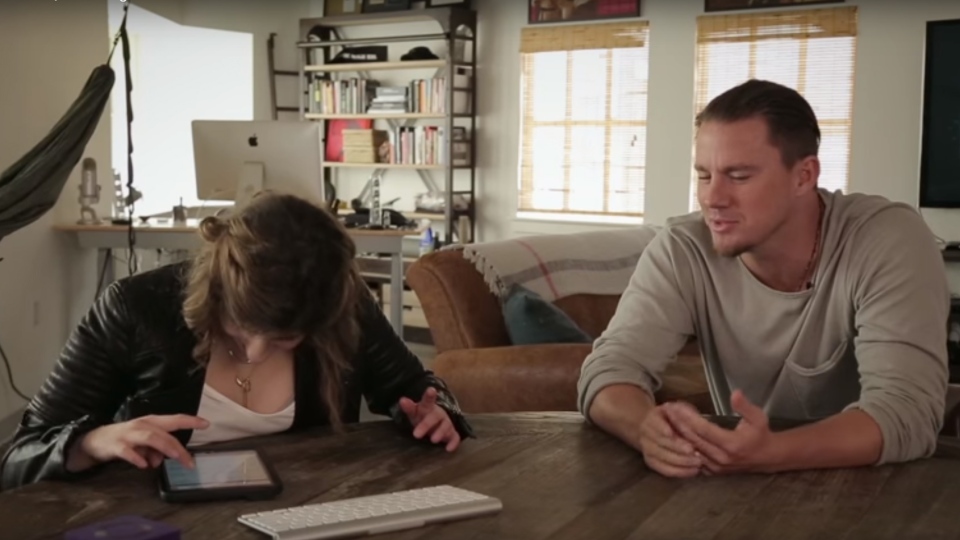
Channing Tatum adds star power to Carly Fleischmann's non-verbal talk show

CTV National News: A non-verbal talk show?
Carly Fleishmann can't speak, but she's opening up a world of possibilities by communicating through typing. Avis Favaro reports. 
3K
3K

    Karolyn Coorsh, CTVNews.ca Staff
    Published Friday, May 6, 2016 10:15PM EDT 
    A smart and sassy 21-year-old who has autism has created a talk show in the hopes of inspiring others to find their voice.  
    Carly Fleischmann, of Ontario, can’t speak, but that hasn’t stopped her from launching what is believed to be the world’s first-ever non-verbal talk show.
    The online show, called “Speechless” is going viral after she snagged one of Hollywood’s hottest stars for her debut interview – actor Channing Tatum.
    As host of the show, Fleischmann types her questions, which are then voiced by her computer and posed to the interviewee.
    Many people assumed that Fleischmann’s future was limited after she was diagnosed with autism and oral motor apraxia at age two. But after learning to type, Fleischmann revealed her razor-sharp mind. Since then, she has co-published a book, appeared on multiple TV shows, and is now aiming to become the world’s first non-verbal talk show host with autism. Her objective, she says, is to “prove that it doesn’t matter what comes out of your mouth, it’s the voice within that needs to shine.”
    And she doesn’t shy away from the asking provocative questions.
    In her interview with Tatum, Fleischmann asks, “Would you date a 21-year-old person with autism?” Tatum quips: “Yes … but I have to get my wife’s permission first.”
    Fleischmann’s shoots back: “Alright, I’ve got my lawyers working on your divorce papers as we speak.”  
    And she didn’t stop there, asking Tatum about his previous career as a male stripper. “How many girls at the end of your night would take you home” she asks as Tatum laughs.
    Her mother, Tammy Starr, said she was “laughing my head off” when saw the interview.
    “I couldn’t believe the question,” Starr said of her daughter’s bold style. “These are questions he’s never been asked … before.”
    Fleischmann is hoping a major network picks up her show.
    Laurie Mawlam, executive director of Autism Canada called Fleischmann an inspiration.
    “Ultimately, we should all follow our dreams and that is what she is doing,” Mawlam told CTV News. “Autism is not an obstacle for her.”
    With a report by CTV News medical specialist Avis Favaro and producer Elizabeth St. Philip
    Wheelchair controlled by facial expressions to hit the market within 2 years

    Wheelchair controlled by facial expressions to hit the market within 2 years


    Wheelie uses facial commands to move
    Wheelie uses facial commands to move. View gallery (4 images)
    Brazilian researchers have developed a wheelchair that can be controlled through small facial, head or iris movements. The team at Faculdade de Engenharia Elétrica e de Computação da Universidade Estadual de Campinas (FEEC/Unicamp) says the technology could help people with cerebral palsy, those who have suffered a stroke or live with amyotrophic lateral sclerosis and other conditions that prevent precise hand movements.
    The team started to look into brain-computer interface (BCI) techniques (the acquisition and processing of signals that allow communication between the brain and an external device) in 2011. The group then decided to test those techniques in a real life situation.
    The researchers built their prototype from a standard motored chair, removed the joystick and equipped it with sensors that can gauge the distance between walls and other objects, and pick up variations on floor surface.
    A notebook that sends commands directly to the chair using a 3D camera running on Intel's RealSense technology was installed, which caters for interaction with a computer through facial and body expressions. RealSense is a stand-alone camera that uses depth-sensing technology and can be attached to any computer. The set includes a standard camera, an infrared laser projector, an infrared camera and a microphone array.
    "The camera can identify more than 70 facial points around the mouth, nose and eyes. By moving these points, it is possible to get simple commands, such as forward, backward, left or right and, most importantly, stop," says the researcher Eleri Cardozo. Voice interaction is also possible, but the researchers say it less reliable because of differences in voice timbre and ambient noise.
    The chair was also equipped with a Wi-Fi antenna that allows a caregiver to steer the equipment remotely through the internet, which could be handy should a wheelchair user get tired. 
    For patients with more serious conditions where facial movement is not possible, the team is also looking into a BCI technology that can pick signals directly from the brain through external electrodes and turn them into commands, though this type of equipment has not been added on the robotic chair yet.
    The research team recently received extra funding to move forward with the project so it can be adapted and marketed in Brazil within the next two years. "Our objective is that the final product costs, at most, twice as much as joystick-controlled models, which sell for around R$7,000 (US$1,994)." To do that, a start-up called Hoo-Box has been created, which will focus on developing the Wheelie system further.
    The researchers presented their project at the Third Brainn Congress in the city of Campinas, Brazil, in April.
    Source: Fapesp

    Selasa, 03 Mei 2016

    The ALS Association 2016 Clinical Conference

    The ALS Association 2016 Clinical Conference

    The ALS Association 2016 Clinical Conference call for presentations and posters is now open. Submissions will be accepted until May 27, 2016.  

    This conference will be a two-day clinical conference for allied health professionals, clinic coordinators, practice administrators and social workers.  

    The conference will focus on exchanging information on best practices and emerging trends in ALS care.  Updates on adaptive technologies, respiratory devices, options for augmentative communication, end-of-life, psychological and allied health issues will also be featured.

    Intended inference participants include speech language pathologists, social workers and counselors, nurses, assistive technology specialists, physical and occupational therapists, respiratory therapists, dietitians, physicians, and research coordinators.  

    We welcome abstracts for platform (speaking) presentations of a variety of ALS-relevant topics: innovative approached to clinical management, potential solutions to challenges faced by people living with ALS, family/caregiver support and outreach strategies.  Individual speakers, panel discussion, and research updates are welcome.  Speakers should plan on a 30 or 30 minute time slot.  All accepted speakers and poster presenters will be offered complimentary registration for the conference.  

    Suggested topics for the 2016 Clinical Conference (please note these are only suggestions. We welcome ANY ALS Clinical Submission)

    The Disease
    Introduction to ALS
    Physical Activity for People with ALS
    Genetics in ALS

    Research and Clinical Trials
    Clinical Trials in ALS (past, present, future)
    National ALS Registry

    Clinical Management
    Adaptive and Assistive Technology
    Outreach programs to Underserved Areas
    Nutrition Management and PEGs
    Genetic Counseling and Testing
    Palliative Care and Hospice Services
    Cognitive and Behavioral Assessment and Management
    Respiratory Decisions and Options Along the Journey
    Symptom Management
    Driving Issues
    Psychosocial Issues in ALS
    Quality of Life Issues
    Issues of End of Life Care
    Communication Challenges and Strategies
    Multidisciplinary Teams
    Scientific Investigation of Alternative Treatments
    Mobility and Activities of Daily Living
    Diagnosis and Management of ALS/MND in Spectrum in Clinic
    Speech and Swallowing Interventions and/or Techniques

    Social Work Practices and Programs
    Support for Children, Teen, and Young Adults
    Assessing and Meeting Caregiver Needs
    Intimacy and Spirituality in ALS
    Advanced Planning
    Care Management and Professional Boundaries

    Insurance and Financial Resources
    Financial Issues – Health and Life Insurance Resources
    Funding for Assistive Technology
    How to Ensure that Insurance Overs Prescribed Durable Medical Equipment
    Updates on Medicare Changes
    Skilled vs. Custodial Home Healthcare coverage – Medicare/Medicaid/Private Insurance

    Supporting Professional Caregivers
    Preventing Professional Burnout and Compassion Fatigue
    Energize and Revitalize – Remaining Positive at Work
    Maintaining Work/Life Balance


    Full details about the conference can be found in the official flyer:


    Rabu, 30 September 2015

    Neural Implant Enables Paralyzed ALS Patient to Type Six Words per Minute

    By Eliza Strickland
    Posted

    Photo: Stanford University/Nature Medicine
    A paralyzed ALS patient uses a brain implant to steer a computer cursor to various targets.

    Typing six words per minute may not sound very impressive. But for paralyzed people typing via a brain-computer interface (BCI), it’s a new world record.
    To pull off this feat, two paralyzed people used prosthetics implanted in their brains to control computer cursors with unprecedented accuracy and speed. The experiment, reported today in Nature Medicine, was the latest from a team testing a neural system called BrainGate2. While this implant is only approved for experiments right now, researchers say this demonstration proves that such technology can be truly useful to quadriplegics, and points the way toward regular at-home use.
    The two people who volunteered for this study have amyotrophic lateral sclerosis (ALS), also known as Lou Gehrig’s disease, a degenerative neural disorder that leads to complete paralysis. Lead researcher Jaimie Henderson, co-director of Stanford’s Neural Prosthetics Translational Lab, calls it a “humbling experience” to work with quadriplegic patients who willingly undergo brain surgery and devote themselves to science experiments that will push forward this early-stage technology. “They’ve become true partners with us in this endeavor,” Henderson says.
    The BrainGate2 system consists of an array of minuscule electrodes implanted, in this case, in a region of the motor cortex known as the “hand knob.” The electrodes record the patterns of electrical activity in the neurons there, which fire when the person either moves or imagines moving their hand. The BrainGate2 system also includes decoding software, which turns a messy signal into a clear command for an external device—in this case, a computer cursor. Other experiments have used BCIs to control robotic arms, and they could theoretically be used to control wheelchairs, cars, or anything else that can be moved by remote control.
    In this study’s first task, the participants repeatedly moved their cursors to targets on a computer screen (see video below), which they accomplished by imagining their index fingers moving on computer trackpads. They each averaged about 2.5 seconds per target. This is a significant improvement over a previous BrainGate2 trial, in which a different patient performed the same task but averaged 8.5 seconds per target.

    The improvement, Henderson says, came from four factors.
    1) The system architecture provided faster processing than before. With a lag time of only about 20 milliseconds between the user’s thought and the cursor’s action, the participants got useful feedback while doing the task.
    2) Signal processing filters carefully extracted the neural signals from the ambient electromagnetic noise—a necessity, as these experiments were conducted in the volunteers’ homes.
    3) The imagined motion that the participants ultimately used to control the cursor (an index finger moving on a trackpad) provided a clearer neural signal than other imagined motions they tried out (whole arm and wrist movements).
    ​4) Perhaps most importantly, an improved decoding algorithm was better able to translate neural signals into intended movements. Essentially, it was better able to identify the direction the user intended to steer the cursor, and could therefore correct for deviations in the neural signal that would have otherwise steered the cursor off track.
    But what about the typing, you ask? For that task, the participants used the same imagined finger movement to pick out letters in a text-entering program called Dasher. With this interface, once the user selects a letter, the program predicts which letters are likely to come next and makes them easier to select, speeding up the construction of words.

    One of the participants typed 115 words in 19 minutes, or about 6 words per minute. That user had previous experience with the Dasher interface using a different control method, but it’s still a pretty impressive result. While this participant is still able to talk naturally, such a communication method could benefit people who have lost the ability to control their mouth muscles, such as people with more advanced ALS or “locked-in” patients.
    Henderson and his colleagues have previously surveyed people with paralysis to see whether they’d be eager to adopt BCI technologies in their everyday lives, and what capabilities they’d hope to gain from such gear. High on the wish-list was the ability to communicate easily through fast typing, which the survey defined as 40 words per minute.
    Henderson says he has plenty of ideas for how to reach that ambitious target. A future study might make use of electrodes implanted in a region of the brain that encodes a person’s intentions to move, before they actually make a motion. “We want to see if using those signals from the planning part of the brain helps improve performance,” he says.
    It’s not clear what level of performance will be required before an implanted BCI device is considered ready for domestic use. But Henderson thinks the BrainGate2 system is well on the way: “We think we’re making very good progress,” he says.   

    Senin, 28 September 2015

    With the Movement of an Eyebrow, Als Patient O’brien Has Won Awards

    With the Movement of an Eyebrow, Als Patient O’brien Has Won Awards

    For some 10 years, using just his eyebrows, Leonard Florence Center For Living (LFCFL) resident Patrick O’Brien – who has ALS and cannot move anything but his eyebrows – worked away at creating what he hoped would be his greatest masterpiece on film.
    A filmmaker before getting ALS, he was inclined to document the entire process of the disease’s progression, and did so quite well.
    As the disease progressed, though, it became harder for him to work on the film. Several editors had helped him with the project, but nothing seemed to take the nearly-finished film from good to great.


    Then, by coincidence, Documentarian Doug Pray entered the picture, and he and O’Brien formed a team that finally got the film out to the world.
    And the world has loved it.
    With O’Brien and Pray working together, ‘Transfatty Lives’ was born, and now the film is garnering awards from New York City to Milan. Earlier this year, O’Brien’s film won the Tribeca Film Festival in its category, and just this past Sunday it won the Audience Award at the Milano Film Festival in Italy.
    “What a long, strange trip it’s been,” said O’Brien this week over e-mail. “The movie almost didn’t get finished. It was by luck that our composer, Bradford Reed, bumped into filmmaker Doug Pray one night at a party. Doug watched a rough cut of the movie and wrote a six-page letter to me about how to fix my movie, then titled ‘Everything will be okay.’”
    His letter came just in time, O’Brien said.
    “I had been trying to make the movie work for eight years at that point, and the film needed some fresh eyes,” said O’Brien. “I had been working with a writer and editor named Scott Crowningshield at that stage. It was good, the film, but not great. It had to be great. I had been documenting my life with ALS since the beginning, and it was going to be great. It just needed the right touch. Thank God for Doug Pray, who agreed to come on as a producer. It was good that Doug came onto the scene at that point in time, because by then I had experimented so much with my cokamayme ideas.”
    Pray said in a telephone interview this week that he is incredibly honored to have worked with O’Brien.
    “By the time I met Patrick, he had grown very frustrated and realized this had to be the last big push for his movie,” said Pray. “You can only keep reforming and editing movies for so long. I think we all felt that energy…The film did need help. It was beautiful, but needed help. It was like a wonderful painting that needs a frame. It was so powerful, funny, weird and artsy. No one was going to see if we didn’t make the push and take this on, and the potential for the film was enormous.”
    Pray said O’Brien had gathered all of the footage – years of footage – and had compiled it for quite some time. The trick was to edit all of the raw footage into a great accounting of what O’Brien went through in his ALS journey – a journey that included lying motionless for several years in a Baltimore nursing home, only able to stare at the ceiling.
    Once arriving at the LFCFL, the technology and enormous improvement in his quality of life at the facility’s ALS Green House, allowed him to continue his work and to be a key decision maker and director in the editing of his film.
    Once again, O’Brien did that without the use of any of his body aside from the movement his eyebrows.
    “As filmmakers, we are fussy with our own work, and I can’t imagine what it must have been like for Patrick to be locked in a bed in Boston, not able to move, while these other people all over the place are working on his film,” said Pray. “However, the degree to which he was able to give input and guide us and direct us about where he wanted the film to go is simply remarkable and amazing especially when you consider his situation. I’ll never forget this experience.”
    Pray also said O’Brien’s story about winning Tribeca and Milan – and being able to travel to the Tribeca Festival for his premiere – is a feather in the cap for the LFCFL.
    “It says a lot about the Leonard Florence that they allow people to be themselves and let people live lives that are meaningful – even when they’re paralyzed,” he said. “They supported this whole thing, even getting Patrick down to New York, which wasn’t easy. He couldn’t have done this without the technology available and support of that facility. He couldn’t have done this at a regular nursing home facility. That says a lot about Leonard Florence. It’s not normal; it’s special.”
    The film is not yet available for public viewing due to the fact that it is still in the Film Festival circuit. It will be premiered in Los Angeles later this year, and will have a Boston premiere some time next year, O’Brien said. However, he said people can visit TransFattyLives.com for more information and to view a trailer.
    The LFCL features neurological specialty residences with cutting-edge assistive technology, allowing individuals with ALS (amyotrophic lateral sclerosis, also known as Lou Gehrig’s disease) and MS (multiple sclerosis) to receive skilled nursing care in a nurturing home environment. The 7th annual ALS & MS Walk for Living, a fundraiser to support these individuals as well as the innovative residences, will be held on Sunday, September 27, a
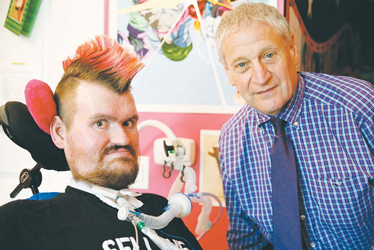
    Filmmaker Patrick O’Brien - who has ALS and can only move one eyebrow - with Chelsea Jewish Foundation CEO Barry Berman last week at O’Brien’s home in the Leonard Florence Center for Living. This year’s ALS Walk for Living on Sunday will pay homage to several awards recently won by O’Brien for his film ‘TransFattyLives.'
    Filmmaker Patrick O’Brien – who has ALS and can only move one eyebrow – with Chelsea Jewish Foundation CEO Barry Berman last week at O’Brien’s home in the Leonard Florence Center for Living. This year’s ALS Walk for Living on Sunday will pay homage to several awards recently won by O’Brien for his film ‘TransFattyLives.’
    t 165 Captains Row on Admirals Hill at 10 a.m.
     
    This year Billy Costa of KISS 108 will act as emcee and kick-off the two-mile walk.  Media sponsors include the Independent Newspaper Group; major corporate sponsors include Biogen, M&T Bank, AHOA, Kayem and Clifton Larson. Immediately following the walk, there will be a BBQ hosted by Chili’s, doughnuts provided by Dunkin Donuts, face painting, live dance performances, a petting zoo, a photo booth and a raffle. There is a $10 donation fee to participate in the Walk, which includes a Walk for Living tee shirt, the BBQ and all the activities. The Walk for Living is one of the few walks that are dog-friendly.

    Rabu, 26 Agustus 2015

    CSUF News Service

    Student Research for ALS Patients

    User-Friendly Prototype Helps People Communicate Online

    ALS Interface TrialStudent David Diaz tests an electronic communication system with the help of alumnus Dean Zarkos, which would allow him and other ALS patients to use a computer using thoughts, facial expressions and head movements.
    Computer engineering major Krystle Ilisastigui hopes her efforts to help develop a high-tech communication device will improve the quality of life for those with amyotrophic lateral sclerosis, or ALS.
    Ilisastigui and several of her classmates are developing an electronic communication system to enable ALS patients to access the Internet and communicate via email, text document, chat or Skype using thoughts, facial expressions and head movements, said Kiran George, associate professor of computer engineering.
    George and his students have worked on the prototype since February — supported by a $100,000 grant from the Oakland-based Disability Communications Fund — and partnered with the ALS Association Orange County Chapter to fine-tune the technology and design.
    This summer, the communication device was tested with the help of patients at the chapter's Tustin office.
    "I have 100 percent faith in you," said Cal State Fullerton alumnus Dean Zarkos, diagnosed with ALS in 2011, as students placed a wireless headset on him.
    With the device, patients like Zarkos — who uses a motorized wheelchair and is unable to move his hands, arms or legs — can communicate online with head tilts and facial expressions.
    "What they are doing is phenomenal: it's cutting-edge technology. Anything that can help patients like myself is a tremendous asset for us," said Zarkos '78 (B.A. political science) of Seal Beach, who holds an MBA and law degree and owns a property management business.
    "I can see it opening up the world for people like me. You can do email — communicate with anybody. These students make me proud to be a Titan."
    ALS, commonly known as Lou Gehrig's disease, is a progressive neurodegenerative disease. An estimated 75 percent of ALS patients lose their ability to speak, along with use of their hands, said George. Speech problems are progressive, and most will experience a severe breakdown in their ability to communicate with others, he added.
    "Patients face tremendous barriers that make electronic communication a challenge. This inability to communicate is equally frustrating and emotionally devastating," George added. "But this device will help them to engage in electronic communication and allow them to stay connected to friends and family."
    What is most appealing about the technology is that the device is user-friendly, requires minimal training and is low cost, observed Jared Mullins '04 (B.A. political science), executive director of the ALS Orange County Chapter.
    The wireless communication system utilizes commercially off-the-shelf components to minimize design time and cost, George explained. The goal is to keep the device's cost under $150.
    While the project allows students to apply what they learn in class and put it to practical use, it also is an eye-opening experience in seeing how their work could help ALS patients regain control of simple tasks.
    "It's been challenging and a great learning experience for us to work directly with the patients," said graduate student David Diaz. "It's real hands-on — something you are not going to get in the classroom."
    Fellow graduate student Aaron Castillo added that one of the biggest challenges has been to personalize the device to meet patients' needs as the disease progresses.
    "We're going to give this project everything we have; we just want to help," Castillo said.
    George and his students also are working on other brain-controlled systems for ALS patients, in which thoughts and expressions can be used to control a robotic arm and electric wheelchair.
    For more photos, visit online. 
    - See more at: http://news.fullerton.edu/2015su/ALS-research.aspx#sthash.VTDHjMjP.dpuf