-->
Tampilkan postingan dengan label autism. Tampilkan semua postingan

Rabu, 11 Mei 2016

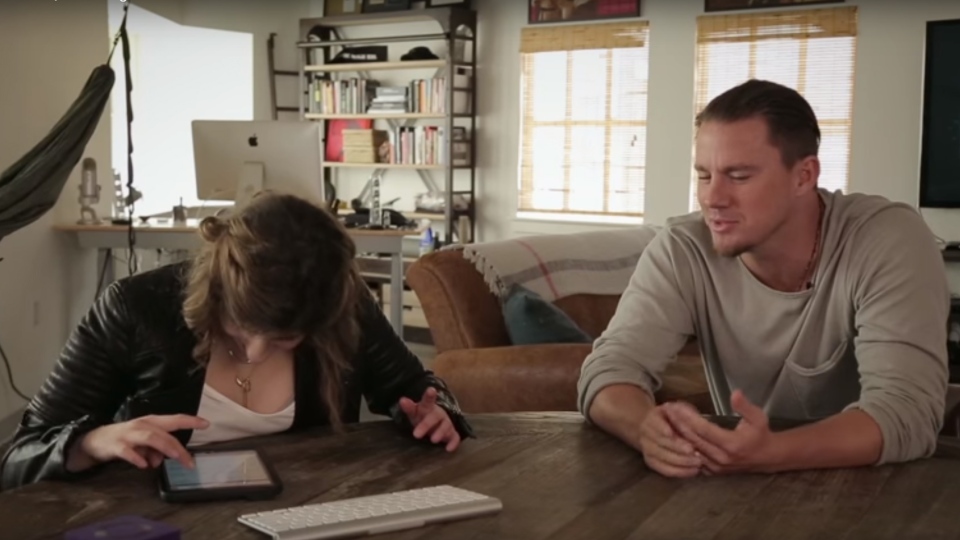
Channing Tatum adds star power to Carly Fleischmann's non-verbal talk show

CTV National News: A non-verbal talk show?
Carly Fleishmann can't speak, but she's opening up a world of possibilities by communicating through typing. Avis Favaro reports. 
3K
3K

    Karolyn Coorsh, CTVNews.ca Staff
    Published Friday, May 6, 2016 10:15PM EDT 
    A smart and sassy 21-year-old who has autism has created a talk show in the hopes of inspiring others to find their voice.  
    Carly Fleischmann, of Ontario, can’t speak, but that hasn’t stopped her from launching what is believed to be the world’s first-ever non-verbal talk show.
    The online show, called “Speechless” is going viral after she snagged one of Hollywood’s hottest stars for her debut interview – actor Channing Tatum.
    As host of the show, Fleischmann types her questions, which are then voiced by her computer and posed to the interviewee.
    Many people assumed that Fleischmann’s future was limited after she was diagnosed with autism and oral motor apraxia at age two. But after learning to type, Fleischmann revealed her razor-sharp mind. Since then, she has co-published a book, appeared on multiple TV shows, and is now aiming to become the world’s first non-verbal talk show host with autism. Her objective, she says, is to “prove that it doesn’t matter what comes out of your mouth, it’s the voice within that needs to shine.”
    And she doesn’t shy away from the asking provocative questions.
    In her interview with Tatum, Fleischmann asks, “Would you date a 21-year-old person with autism?” Tatum quips: “Yes … but I have to get my wife’s permission first.”
    Fleischmann’s shoots back: “Alright, I’ve got my lawyers working on your divorce papers as we speak.”  
    And she didn’t stop there, asking Tatum about his previous career as a male stripper. “How many girls at the end of your night would take you home” she asks as Tatum laughs.
    Her mother, Tammy Starr, said she was “laughing my head off” when saw the interview.
    “I couldn’t believe the question,” Starr said of her daughter’s bold style. “These are questions he’s never been asked … before.”
    Fleischmann is hoping a major network picks up her show.
    Laurie Mawlam, executive director of Autism Canada called Fleischmann an inspiration.
    “Ultimately, we should all follow our dreams and that is what she is doing,” Mawlam told CTV News. “Autism is not an obstacle for her.”
    With a report by CTV News medical specialist Avis Favaro and producer Elizabeth St. Philip

    Senin, 06 Juli 2015

    AT&T, NYU launch challenge to help develop technology for people with disabilities

    AT&T, NYU launch challenge to help develop technology for people with disabilities


    The AT&T NYU Connect Ability Challenge is a three-month global software development competition leveraging mobile and wireless technologies to improve the lives of people living with disabilities.AT&T via Youtube

    The AT&T NYU Connect Ability Challenge is a three-month global software development competition leveraging mobile and wireless technologies to improve the lives of people living with disabilities.

    AT&T is partnering with NYU's Ability Lab to celebrate the passage of the Americans with Disabilities Act and help develop new technology for those with disabilities with a new initiative.
    The Connect Ability Challenge is a three-month software development competition focused on developing mobile and wireless technology that can help improve the lives of people with physical, social, emotional, and cognitive disabilities.
    Some of the software that was submitted includes smart glasses for the visually impaired, apps for people with autism and dementia, software for those with speech impediments and headgear for those diagnosed with ADHD. There are 63 submissions in total online.
    Marissa Shorenstein, president of AT&T New York, said the challenge was inspired by other competitions created over the past years across the country and world to find technology for several sets of issues. This year's would focus on the disabilities in honor of the 25th anniversary of the ADA.
    "It's a collaborative process, but it's also a competition," Shorenstein. "I'm very encouraged by the action of the exemplars."
    Xian Horn is one of the exemplars and judges of the Challenge. She is a teacher, speaker and writer from Manhattan who has cerebral palsy.AT&T via Youtube

    Xian Horn is one of the exemplars and judges of the Challenge. She is a teacher, speaker and writer from Manhattan who has cerebral palsy.

    Developers will be judged by four exemplars—along with other AT&T executives—who have different disabilities. They will be able to genuinely review developed software and help choose a winner they think will impact the lives of many in their communities.
    The four exemplars are: Xian Horn, a teacher, speaker and writer from Manhattan who has cerebral palsy; Paul Kotler, a lecturer and student from Philadelphia who has autism. Kolter communicates using computer-assisted technology and struggles with impulse control; and Jason DaSilva, a filmmaker from Brooklyn who has Multiple Sclerosis.
    The fourth exemplar is Gus Chalkias, who works as an assistive technology specialist, career counselor and college student from Queens and is blind.
    "It's been amazing for me to be part of something that is bigger than this contest," Chalkias told the Daily News. "I think it's setting a standard for people with disabilities. It's taking a stance where they are saying we need to include people with disabilities."
    Paul Kotler, who is also judging the software, is a lecturer and student from Philadelphia who has autism. Kolter communicates using computer-assisted technology.AT&T via Youtube

    Paul Kotler, who is also judging the software, is a lecturer and student from Philadelphia who has autism. Kolter communicates using computer-assisted technology.

    Chalkias, along with the other exemplars, will be looking to see if the software and hardware submitted solves four functional categories and one category addressing public policy for the disabled community. The categories are: people with sensory disabilities, people in need of mobility solutions, social and emotional solutions, solutions for people with communicative and cognitive disabilities and solutions impacting policy and society.
    "My biggest desire is to have some kind of technology that can get me from point 'A' to point 'B' without stopping and asking someone if I'm in the right place or room," Chalkias said. "I'm blind in a time where technology can actually meet my needs."
    Kotler, who hopes the challenge improves the lives of millions, said that as a judge he's very impressed with the quality and thoughtfulness of the presentations.
    "We hosted collaborations sessions a few weeks ago to help guide the developers and provide feedback prior to the submission deadline," Kotler said. "There were many apps and products that I thought were outstanding and I can't wait to see all that have been created and submitted."
    The AT&T NYU Connect Ability Challenge is currently letting the public vote on submissions. Public Voting will end on July 10.AT&T via Youtube

    The AT&T NYU Connect Ability Challenge is currently letting the public vote on submissions. Public Voting will end on July 10.

    Developers have already submitted their software and it's currently being judged by the exemplars. The challenge is also open to the public, who can vote until July 10 on the Connect Ability Challenge's website.
    The winners of the challenge will be announced on July 26, which is the anniversary of the enactment of the ADA. More than $100,000 in cash prizes will be awarded to developers in the five categories.
    "While I hope that the winning solution or technology will help improve the lives of people living with autism, I also hope that the challenge has inspired developers across the world to build new tech that focuses on the user and incorporates the feedback from our community," Kotler. "I think that one of the most important things to come out of this competition will be the awareness that I am hoping developers will build."
     

    Selasa, 23 April 2013

    Beleaguered Caregivers Getting Help from Apps

    Beleaguered Caregivers Getting Help from Apps

    Via http://www.wirelessdesignmag.com/news/2013/04/beleaguered-caregivers-getting-help-apps


    NEW YORK (AP) — As her mother and father edged toward dementia, Nancy D'Auria kept a piece of paper in her wallet listing their medications.

    It had the dosages, the time of day each should be taken and a check mark when her folks, who live 10 miles away, assured her the pills had been swallowed.

    "I work full time so it was very challenging," said D'Auria, 63, of West Nyack.

    Now she has an app for that. With a tap or two on her iPhone, D'Auria can access a "pillbox" program that keeps it all organized for her and other relatives who share in the caregiving and subscribe to the app.

    "I love the feature that others can see this," D'Auria said. "I'm usually the one who takes care of this, but if I get stuck, they're all up to date."

    From GPS devices and computer programs that help relatives track a wandering Alzheimer's patient to iPad apps that help an autistic child communicate, a growing number of tools for the smartphone, the tablet and the laptop are catering to beleaguered caregivers. With the baby boom generation getting older, the market for such technology is expected to increase.

    The pillbox program is just one feature of a $3.99 app called Balance that was launched last month by the National Alzheimer Center, a division of the Hebrew Home at Riverdale in the Bronx.
    "We thought there would be an opportunity here to reach caregivers in a different way," said David Pomerantz, executive vice president of the Hebrew Home. "It would be a way to reach people the way people like to be reached now, on their phone."

    The app also includes sections for caregiving tips, notes for the doctor and the patient's appointments, plus a "learning section" with articles on aspects of Alzheimer's and an RSS feed for news about the disease.

    Trackers are also important tools for Alzheimer's caregivers.

    Laura Jones of Lighthouse Point, Fla., says she was able to extend her husband's independence for a year and a half by using a program called Comfort Zone.

    "He was just 50 when he was diagnosed," she said.

    Jones said she went to work so he would continue to get insurance coverage.

    "Day care was not appropriate, home care was not affordable," she said. "Even when he stopped driving, he would ride his bike all over town, to the gym, for coffee, errands. He would take the dog for a walk and be out and about when he was alone and I was working."

    Using Comfort Zone, which is offered by the Alzheimer's Association starting at $43 a month, she was able to go online and track exactly where he was and where he had been.

    Her husband carried a GPS device, which sent a signal every five minutes. If Jones checked online every hour, she would see 12 points on a map revealing her husband's travels. She would also get an alert if he left a designated area.

    Eventually, the tracking revealed that Jones' husband was getting lost.

    "He would make a big funny loop off the usual route and we knew it was time to start locking down on him," she said.

    Mended Hearts, an organization of heart patients and their caregivers, is about to start a program to reach caregivers by texting tips to their phones.

    "We hope this will be the beginning of several patient- and caregiver-based texting programs that reach people where they are," said executive director Karen Caruth.

    Lisa Goring, vice president of Autism Speaks, said tablets have been a boon to families with autistic children. The organization has given iPads to 850 low-income families. And the Autism Speaks website lists hundreds of programs — from Angry Birds to Autism Language Learning — that families have found useful.

    Samantha Boyd of McConnellstown, Pa., said her 8-year-old autistic son gets very excited when the iPad is brought out.

    "There's no way he'd be able to use a keyboard and mouse," she said. "But with the iPad, we use the read-aloud books, the songs, the flash card apps."

    She said the repetitiveness and visuals help. "He catches a word and repeats it back. He says the name of a picture, and the iPad says it back."

    Boyd said the iPad also works as a reward: "He likes to watch Netflix on it."

    One of the most popular online tools for caregivers is one of the oldest: the message board, available all over the Internet and heavily used by caregivers of dementia and autism patients, who perhaps can't find the time for conventional support groups.

    "It's a place for families to talk about the strengths and the accomplishments of their child with autism but also talk about some of the challenges and be able to find the support of other families," Goring said.

    Some tools are not specific to a particular disease or condition.

    CareFamily, which prescreens in-home caregivers and matches them to customers over the Internet, has online tools that let a family remotely monitor a caregiver's attendance, provide reminders about medications and appointments, and exchange care plans and notes via email, texting or phone.
    "We're in the infancy of what technology can do for caregiving and it's only going to grow," said Beth Kallmyer, a vice president at the Alzheimer's Association.

    But she cautioned that it's too soon to depend entirely on online tools.

    "It's not a good fit for everybody," she said. "When you're looking at people impacted by Alzheimer's disease, including some caregivers, you're looking at an older population that might not be comfortable. We always have to remember technology is great — when it works."