-->
Tampilkan postingan dengan label disability. Tampilkan semua postingan

Rabu, 22 Maret 2017

Elderly And Disabled Assistive Technology Market To Surpass $26 Billion By 2024

Elderly And Disabled Assistive Technology Market To Surpass $26 Billion By 2024

The World Health Organization (WHO) estimates that 285 million people are visually impaired worldwide. 70 million people need a wheelchair. Another 360 million people globally have moderate to profound hearing loss. Globally, more than 1 billion people need one or more assistive products.

The global elderly and disabled assistive devices market was valued at $14 billion in 2015 and is expected to surpass $26 billion by 2024, according to Coherent Market Insights. It is a sizable market with an incredibly diverse set of needs. Many products have to be customized which is why 3D printing is an ideal way to study and solve some of it.


Photo from MatterHackers Envision the Future Design Challeng

MatterHackers, one of the largest 3D printing retailers in the U.S., wants to put a big dent in those numbers by encouraging inspiring, low-cost or free, assistive device models that people can 3D print or build from some other material. Officially, the “Envision The Future Design Challenge” is to create educational tactile models and assistive devices for the blind and visually impaired.

WHO defines assistive technology as any product that helps maintain or improve an individual function. Hearing aids, wheelchairs, eyeglasses, prostheses, pill organizers, and memory aids are all examples of assistive devices or products. You do not have to go far in 3D printing circles to find solutions or at least potential ideas to solve these sorts of problems or issues -- and I have written about many of them -- from custom insoles (orthotics) to hearing aids to haptic feedback in a glove (one of my very first posts over 5 years ago).
With an aging global population and a rise in noncommunicable diseases, more than 2 billion people will need at least 1 assistive product by 2050, with many older people needing 2 or more, according to a WHO assistive device fact sheet.

With an aging global population and a rise in noncommunicable diseases, more than 2 billion people will need at least 1 assistive product by 2050, with many older people needing 2 or more, according to a WHO assistive device fact sheet.
One of the more famous assistive device designs, not part of the MatterHackers design challenge, comes from the e-NABLE Community: the “Iron Man” video tells the story of Robert Downey Jr. giving an Ironman prosthetic hand to a child. Awesome video. That design was developed by the UCF Armory (University of Central Florida), led by Albert Manero, the Limbitless Arm was e-NABLE’s first myoelectric design. The Limbitless Arm is licensed under the Creative Commons-Attribution-Non-Commercial license. Success stories like these inspire more people to realize how accessible 3D technology is making incremental and exponential improvements possible -- that you might have an idea that could change the world for you or someone else.

Given that so many people have a need for assistive devices and products across a wide range; 3D printing is one of the best ways to approach the problems. If you look at an organization like Enabling The Future, that crowdsources the making of 3D printable prosthetic hands, a design challenge can provide new ideas and solutions that might not otherwise make it to market. Plus, it spreads the word and inspires more people, design-minded people, to consider how they might approach this massive market need and opportunity.
Additional resources:

Briefly, because everyone wants to know about prizes when there's a challenge like the Envision The Future Design Challenge, there are two categories: Youth (under 18) and Adults (18 and over). Each category will have 1st, 2nd, and 3rd place winners with prizes sponsored by LulzBot and MatterHackers. Youth grand prize is a Lulzbot Mini 3D Printer (don’t let the name fool you; it is a decent size printer). Adult grand prize is a Lulzbot TAZ 6 (larger print area than the Mini). Both grand prize categories also come with a MatterControl Touch T10 - 10.6" Standalone 3D Printer Controller – basically a tablet you can use to run a printer without needing a full computer. The challenge runs from March 202017 through May 8, 2017 and the full details are here.


Coherent Market Insights produced the Elderly and Disabled Assistive Devices - Evolving from Luxury to Necessity report; a summary is available here.
Rabu, 13 November 2013

All Technology Is Assistive Technology

All Technology Is Assistive Technology

    I love Graham Pullin's book and recommend it highly!!
    ==========================
     

    All Technology Is Assistive Technology

    Six dispositions for designers on disability

     
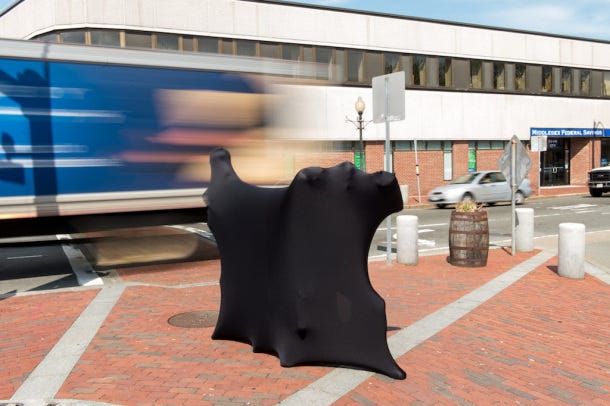
    • Unknown Armature: Body Socks / Sara Hendren
    Unknown Armature: Body Socks / Sara Hendren

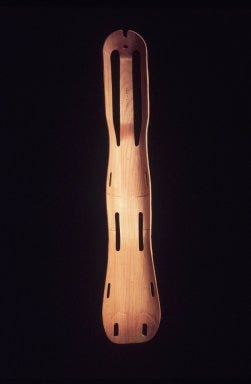
    In 1941, the husband-and-wife design team, Charles and Ray Eames, were commissioned by the US Navy to design a lightweight splint for wounded soldiers to get them out of the field more securely. Metal splints of that period weren’t secure enough to hold the leg still, causing unnecessary death from gangrene or shock, blood loss, and so on.

    The Eameses’ unpainted wood splint, curved at its edges to keep the leg from falling off, with a targeted set of slots and holes for tying secure restraints.
    The Eameses had been working on techniques to mold and bend plywood, and they were able to come up with this splint design—conforming to the body without a lot of extra joints and parts. The wood design became a secure, lightweight, nest-able solution, and they produced more than 150,000 such splints for the Navy.
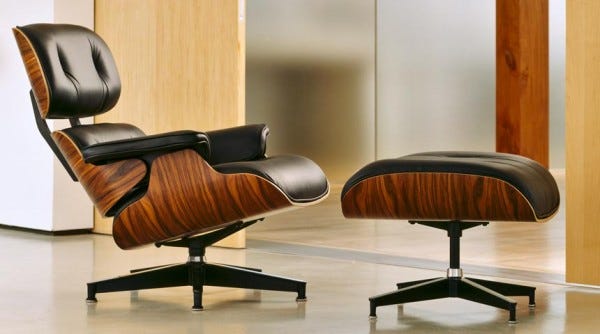
    Over the next decade, the Eameses would go on to refine their wood-molding process to create both sculpture and functional design pieces, most notably these celebrated chairs:
    A classic model of an Eames recliner and ottoman, each with an understructure of molded stained wood, highlighting the curve of the grain around its edges, and black leather upholstery.
    Graham Pullin, in his book, Design Meets Disability, cites this story as an example of a seemingly specialized design problem—a medical aid for disabled soldiers—that inspired a whole aesthetic in modernist furnishings. The chairs that launched a thousand imitators, and a new ethos of simple, organic lines in household objects.
    It’s easy to assume that the innovation would more often happen in reverse: that a generalized design solution would “trickle down” to the narrow confines of adaptive and assistive aids. But this example, as Pullin points out, suggests that disability concerns are an overlooked area of aesthetic generativity, with relevance and impact for design far outside its starting questions.
    More than that, I think it demonstrates why everyone should pay more attention to disability matters.
    You might imagine that “disability studies” is just one more category of identity that’s purely for political advocacy, interesting only to those directly affected by issues of accessibility, accommodation, or special rights. But “disabledness” is a far more slippery designation than even the other notorious ways cultures have of historically organizing themselves—along the lines of race, gender, ethnicity, and the rest. And while these latter categories have also been shown to be much less stable than once thought, disability is another matter altogether. There are at least two big reasons why disability concerns are everyone’s concerns.
    First, it’s a false divide to make a we/them: either able-minded, able-bodied, or disabled. After all, how cultures define, think about, and treat those who currently have marked disabilities is how all its future citizens may well be perceived if and when those who are able-bodied become less abled than they are now: by age, degeneration, or some sudden—or gradual—change in physical or mental capacities. All people, over the course of their lives, traffic between times of relative independence and dependence. So the questions cultures ask, the technologies they invent, and how those technologies broadcast a message about their users—weakness and strength, agency and passivity—are important ones. And they’re not just questions for scientists and policy-makers; they’re aesthetic questions too.
    Second, in many cultures—and certainly in the US—a pervasive, near-obsession with averages and statistical norms about bodies and capacities has become a naturalized form of describing both individuals and populations. But this way of measuring people and populations is historically very recent, and worth reconsidering.
    Disability studies scholar Lennard Davis writes that
    “before the nineteenth century in Western culture, the concept of the ‘ideal’ was the regnant paradigm in relation to all bodies, so all bodies were less than ideal. The introduction of the concept of normality, however, created an imperative to be normal, as the eugenics movement proved by enshrining the bell curve (also known as the ‘normal curve’) as the umbrella under whose demanding peak we should all stand. With the introduction of the bell curve came the notion of ‘abnormal’ bodies. And the rest is history.” Bending Over Backwards: Disability, Dismodernism, and other Difficult Positions
    You all know the bell curve, of course.
    A chart of a classical bell curve, this one measuring “the severity of language disorders.” Standard scores, as usual, fall into the widest part of the curve.
    It’s the source of all talk about how individuals measure up, relative to others. In case you doubt this obsession, I invite you to witness the conversation among parents of young children: It’s all percentiles, and milestones, and being “ahead of the curve” with respect to each month of a child’s development. Exceptional normal-ness is what they prize above all else, and it’s these measurements that can reassure anxious caregivers, despite little correlation between these measures and a lifetime of wellness, healthy relationships, or sustaining work.
    Again, Davis reminds us that this is a recent set of cultural ideas, so unquestioned now that these standards have a way of “enforcing normalcy.”
    Of course,as Davis writes,“it’s too easy to say, ‘We’re all disabled.’” But it’s a challenge to interrupt cultural assumptions in powerful, creative ways—and to alter wider collective thinking about one’s own individual dependence, independence, and that of others.
    So how might designers and artists engage these myths about what’s normal, and make more visible, critical, and expansive technologies that keep these questions alive?
    Well—it’s worth saying again: All technology is assistive technology. Honestly—what technology are you using that’s not assistive? Your smartphone? Your eyeglasses? Headphones? And those three examples alone are assisting you in multiple registers: They’re enabling or augmenting a sensory experience, say, or providing navigational information. But they’re also allowing you to decide whether to be available for approach in public, or not; to check out or in on a conversation or meeting in a bunch of subtle ways; to identify, by your choice of brand or look, with one culture group and not another.
    Making a persistent, overt distinction about “assistive tech” embodies the second-tier do-gooderism and banality that still dominate design work targeted toward “special needs.” “Assistive technology” implies a separate species of tools designed exclusively for those people with a rather narrow set of diagnostic “impairments”—impairments, in other words, that have been culturally designated as needing special attention, as being particularly, grossly abnormal. But are you sure your phone isn’t a crutch, as it were, for a whole lot of unexamined needs? If the metrics were expansive enough, I think the lines around what’s designated as assistive would start to get blurry pretty quickly.
    Undoing the distinctions between design for disability and design in general yields a couple of goods: It brings new attention to technologies that are profound in their use and impact on physical and political accessibility. The advanced replacement limbs, all-terrain wheelchairs, and exoskeletons you can find now are evidence of this new attention.
    It also brings a productive uncertainty and a powerful friction to the task of designing technologies of all kinds. Whether you’re designing for an established need or seeking an application for a technical novelty, you might take more time before confidently assigning it to a user, or to over-determining its modes of deployment—it might be for practical ends, or for play, or for something else you’ve not yet imagined.
    Instead of labeling some technologies and not others as assistive, let’s start like this: We’re all getting all kinds of help from the things we make. All kinds of help, all the time, for our many material and social and educational and political needs. Private needs and public ones. No one is exempt. Then the questions get really interesting: What can a body do? What needs are you interested in? Who might use which thing for what? Where might the surprises be? How might a familiar thing morph into something else altogether?
    In the name of good friction, then, I want to suggest some possible dispositions for designers and artists taking a look at ability and disability.
    1. Question invisibility as the assumed goal.
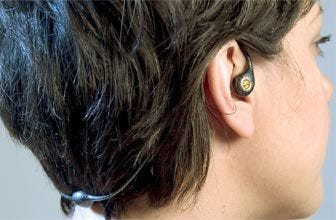
    These hearing aids are reconsiderations of an until-recently neglected prosthesis. Long designed with dubious “flesh toned” plastics and metal circuitry, these devices are now a site of generative research about the nature of hearing. The Victoria&Albert museum’s 2006 exhibit, Hearwear, commissioned designers to reconsider hearing as an under-examined area of exploration.
    A woman wears a jewel-like hearing aid, similar in size and shape to an earbud, draped around the back of the head with thin, elegant wiring.
    A woman wears a necklace that falls from the back of her ears to form a lariat-style pendant beneath her collarbone.
    “The Beauty of Inner Space,” a design by Ross Lovegrove, above, has more in common with jewelry than medical gear. His proposal would have this aid amplify and mute sounds at the user’s discretion—highlighting sounds you want to hear and canceling out others. And the Svara hearing aid, below, is a proposal to make amplification gestures blend seamlessly with other naturalistic movements: moving the necklace’s “pendant” up or down, for example, or tucking one’s hair behind the ears.
    In other words, one strand of design might be devoted to making hearing aids as discreet as possible—to hide its function from view. But another round of questions becomes more interesting altogether: What might a hearing aid also do—or do instead—that’s never even been considered?
    See more hearing aids in the exhibition covered by Designboom.
    2. Rethink the default bodily experience.
    Researchers at Georgia Tech re-imagined wheelchair navigation for quadriplegic users—with a tongue driver. It’s a wireless device that allows those who have high-level spinal cord injuries, and therefore little or no limb movement, to operate computers and their own electric wheelchairs.
    Placing the controls in headsets, say the researchers, made them susceptible to getting jostled and needing frequent recalibration. Moving the entire system inside the mouth makes it stable and reliable, and the tongue’s receptors are sensitive enough that the user can move a cursor on a screen and direct a wheelchair in the way a joystick would have in the past. And the entire system can be programmed for many complex commands at once.
    Instead of approximating a hand movement with joystick directionality, this system exploits a built-in sensitivity goldmine, protected from outside elements. Sometimes heightened functionality is about reconsidering typical adaptations entirely, inverting the expected sensory mechanism.
    3. Consider fine gradations of qualitative change.
    I’m as much a fan of the exoskeletons and bionic limbs as the next person. But there are far more subtle changes for bodies over the lifespan for the designer also to address. Some of the most interesting ideas pose ways to “edit” built environments that already exist, to accommodate more bodies more of the time.
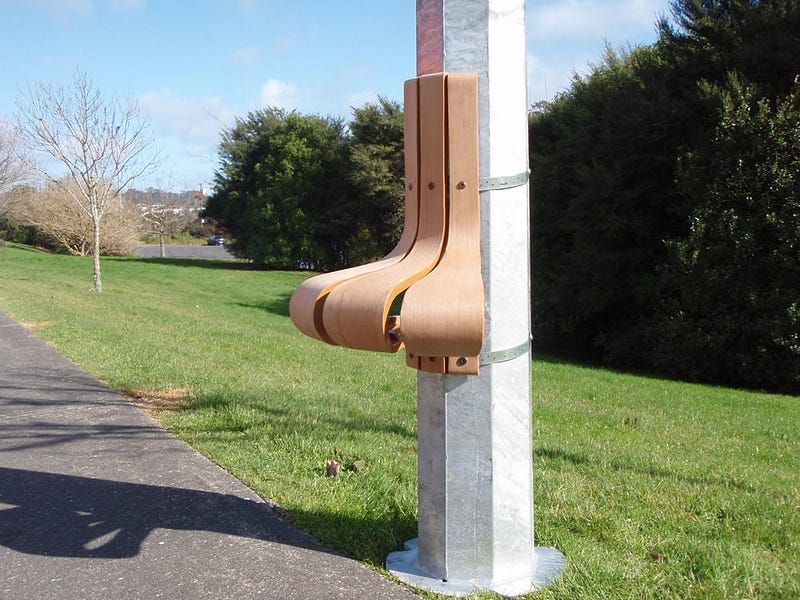
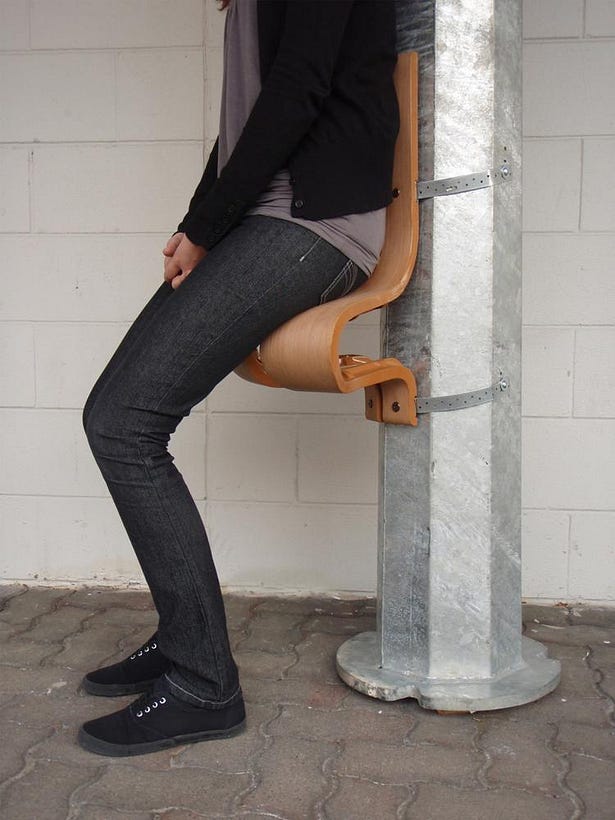
    The Wanderest is just that kind of edit: a perch for pausing on the otherwise relentlessly forward-looking streetscape. As cities consider their usability for aging populations, this kind of accommodation might be as important as newer, “smarter” nursing home environments. Could small structures like these make streets more navigable, make independent living more attainable for a longer period?
    A molded wood perch or chair, with curvilinear strands that welcome a sitter and a body that attaches to a telephone pole or streetlight.
    The same Wanderest perch, this time with a human sitter in it.
    So many medical technologies for treatment are just that: medicalized. They operate with the assumption that a change in ability is primarily a biological condition, without thought for the broader ways the built environment can expand and shift to welcome multiple kinds of bodies and experiences.
    4. Uncouple medical technologies from their diagnostic contexts.
    Temple Grandin is a research scientist in animal husbandry and now a well-known self-advocate for people with autism spectrum conditions. Grandin has revolutionized the cattle slaughter process, creating far more humane tools and practices for a huge percentage of slaughterhouses all across the U.S.
    Along the way, one of the technologies she developed is a “hugging machine” that provides a deep, calming pressure to cows as they enter the conveyor belt toward their deaths. The pressure creates stillness, reduces panic, and makes for a cleaner, less violent death for the animal.
    As she developed this machine for cattle, Grandin intuited her own need for an adaptive “hugging machine” that would provide her with a proxy for human touch. For someone whose interpersonal interactions were often confusing, she found that this machine delivered a kind of affection and calming influence that she needed but wouldn’t get from a typical kind of human relationship.
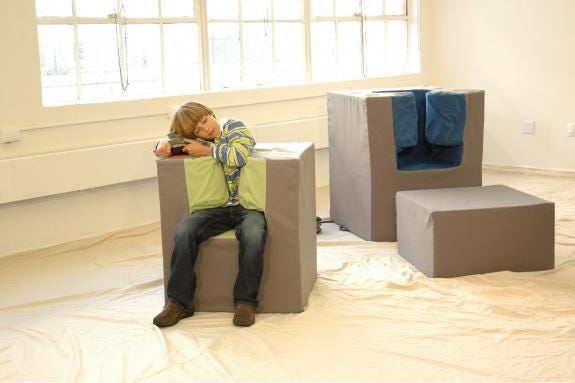
    Artist and MIT professor Wendy Jacob proposed a collaboration with Grandin to modify and replicate the hugging machine—in the form of these “squeeze chairs”—furniture that gives you a hug.
    Boxy upholstered chairs include square, arm-like extensions that press inward from the chairs’ edges—here embracing a young sitter.
    What happens when a tool used for therapeutic reasons also points outward from a diagnostic mode toward something more ambiguous, entering the realm of the poetic? Why shouldn’t a critical object like this one possess more affect, be more responsive? When an object’s uses and users get less clearly marked, new stories about that object and its users can suddenly emerge.
    5. Design for one.
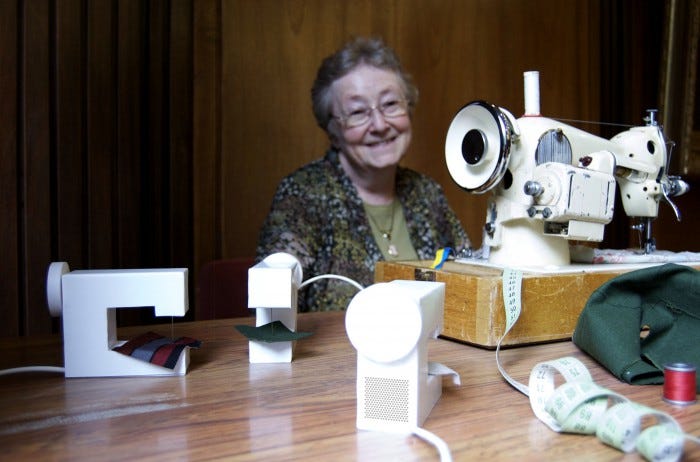
    Michail Vanis, a young interaction designer charged with a design brief about “the future of work,” started to think about his grandmother Despina’s retirement from her job as a seamstress—a job she valued for its camaraderie of fellow workers at their sewing machines in a shared physical space.
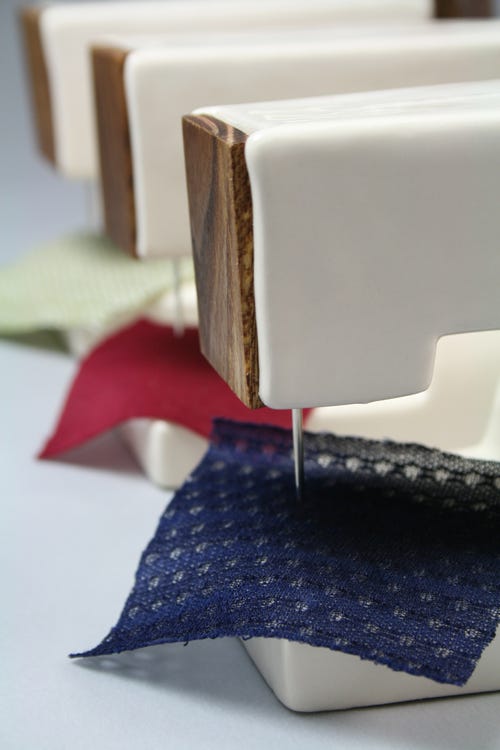
    After her retirement, it wasn’t that Despina needed a chair or adaptive machine to allow her sew in her elder years; it was that she missed the togetherness of colleagues. So Vanis created Social Sewing, a complex of sewing machine avatars that activate when her now far-flung colleagues were also laboring in their post-work contexts.
    A close-up view of white-and-dark-stained wood miniature sewing machines, each complete with “needle” and swatch of fabric.
    A woman smiles in front of her own sewing machine and three small machine avatars that activate when her former colleagues are also sewing.
    This project is about productive, radical constraints: it narrows the design question to a single user, but it suggests a much wider frame for thinking about the “future of work” in all its crucial qualitative senses.
    6. And this is perhaps the most important: Let the tools you make ask questions, not just solve problems.
    The tricky part with popular prosthetic design—bespoke artificial limbs and such—is an overwhelmingly dominant trend toward making people with atypical bodies “pass” as “normal.” Plenty of well-meaning designers set out to re-design an object so that its wearer won’t “appear disabled,” with the presumption that a preconception of “normal” is always desirable.
    Yes—of course—some users want discreet tools! But others roundly reject the notion that all bodies should conform to some standardized or performative ideal.This kind of variability and disagreement should also be a generative friction for the designer. Designed artifacts that reveal psycho-social or cultural dynamics not typically housed in an ability/disability framework can destabilize easy notions of dependence and autonomy, passivity and agency.
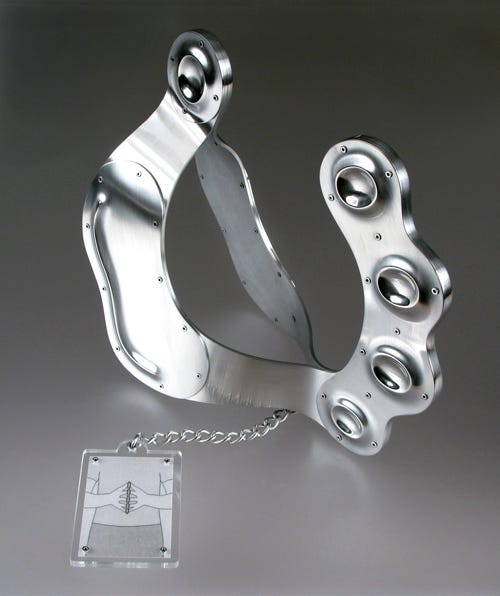
    Jennifer Crupi, an artist and metalsmith, makes a kind of gestural jewelry:
    A polished metal hand-sized tool for training one’s fingers into a power gesture: fingertips on each hand aligned and pressed together, spread wide apart from each other. A small chain attaches a tiny diagram instructing the user how to wear it.
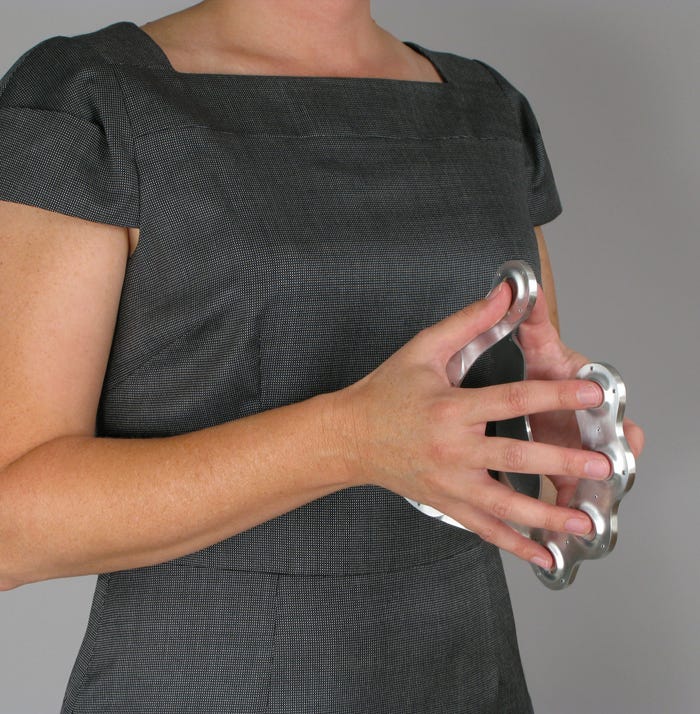
    A woman “trains” her fingers in the power gesture, with the metal tool braced between each finger tip, with nested holes for each digit.
    This design above, Power Gesture, forces its wearer to assume the authoritative position of steepled fingers, held confidently and calmly in front of one’s chest. An assistive device to rehearse one’s self-presentation.
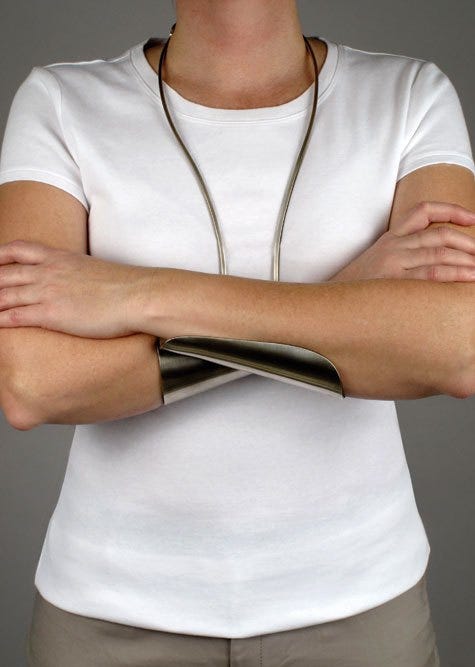
    A woman wears a “necklace” of thick silver wire that ends in two curved resting bowls for her crossed forearms.
    And her Guarded Gesture, above, externalizes the betrayal of emotions that’s so revealing in the crossed-arms stance. With these designs there’s a kind of comedy-with-teeth: Crupi makes a shrewd comment on the sciences of body language—and the ways humans say both what they want to express and what they wish to hide.
    Questions of utility matter: Does it work efficiently? Is its power maximized? Is it user-friendly? Can it be mass produced, affordably? But questions outside utilitarian concerns also matter.Whether interrogative design, or critical design, or “design for debate,” objects and their stories can suggest a para-functionality that makes subtler needs and proxies become visible.
    Allowing objects to raise and suspend questions—indefinitely suspend questions—alongside those objects designed to solve problems helps keep a complex public conversation alive about human normalcy and pathology, about needs and desires for interdependence, about the tools giving assistance to every human body.
    Thanks to Graham Pullin, Katherine Ott, especially this book, Mara Mills, Tim Maly.

    Jumat, 28 Juni 2013

    Forced Intimacy: When Illness Makes Us Let Down Our Guards

    Forced Intimacy: When Illness Makes Us Let Down Our Guards

    With an invading disease come other invasions, of privacy and physical space: Holly Ladd on ALS and intimacy out of necessity                                                                           


    My name is Holly Ladd, and I am a 58-year-old woman with ALS (“Lou Gehrig’s Disease”). I was diagnosed in August 2012, after five months of increasing difficulty walking. Ten months later, I live my life from a wheelchair, no longer able to walk, and I am quickly losing use of my arms and hands. My voice is soft and muffled, and will be useless in a few months.

    In December 2012, I left my 30-year career in public health and international development, in which I traveled alone to Africa and South East Asia. Now, I can’t travel alone from my bedroom to the bathroom.

    Having the support of Joan, my beloved partner of 23 years; my beautifully spirited son, Michael, whom I joyfully watched graduate from college this month; many close friends; as well as excellent medical care and a home health aide seven days a week, I am one of the “lucky” ALS patients. But like all of us with this devastating disease, I am frightened and furious. It has given me much to think about.

    As each week passes, they bore through the rock-hard walls of my self-consciousness, shyness, embarrassment and grief to move in close enough to keep me clean and safe — and I fight them at every turn, mistaking pride for dignity.
     
    Lately, I have been thinking about intimacy. Not sexual or romantic intimacy, but the full range of physical, emotional and — dare I say — spiritual intimacy. We undress in front of our sexual partners, our physicians and maybe strangers in a locker room, but most of us would not consider having someone else routinely remove our clothes. A few special friends may know some of our fears, our secrets and maybe our prayers.

    But generally we guard these parts of ourselves well — some of us very well indeed — with what I like to think of as our personal sentries. These sentries are the tricks, diversions, dodges and distractions we use to keep the world at bay. I imagine mine dressed rather like the Swiss guys in striped pantaloons who guard the pope.

    Among the many choices we have when suddenly sick is whether or not to fire our sentries. Don’t we need them to guard our vulnerable selves even more when we are ill? Isn’t this the time to circle wagons? And how do you know whom to let past the palace guards?

    So far, I have told my sentries to stand down; I have yet to fire them. They are milling about in the corner in their purple and gold stripes, helmets off, with an occasional cigarette passing between them. I might be able to fire them someday, but for now they still keep a watchful eye and spring into action from time to time, like a dog energetically greeting the postal carrier. Even so, while they have been relaxing, greater intimacy has been happening — by choice and by necessity.

    By necessity, there are a whole lot more people in my life now. Most notable are the four women who come at different times and frequencies to care for my daily physical needs. These people bathe me, brush my teeth, wipe me, feed me, get me in and out of bed, and dress and undress me. As each week passes, they bore through the rock-hard walls of my self-consciousness, shyness, embarrassment and grief to move in close enough to keep me clean and safe — and I fight them at every turn, mistaking pride for dignity.

    Some of those who care for me have such a well-worn familiarity with this disease that they anticipate both my physical and spiritual needs before I can imagine going there. They prepare me, and they prepare the path in front of me.

    There are medical providers who know the science and my body — how it is collapsing. Two or three have also seen some of how my heart has broken. And my psychologist helps sort out the feelings I have about impending death from those that were born in ancient losses. With a couple of these, I discuss both heart and health, and they will be trusted with making the final call.

    I think about who can accompany me to appointments based not just on schedules and interests, but on who knows me well enough to speak for me as my voice fails — who knows my fears, as well as my comforts; who knows me well enough to persuade the sentries to let down their guard.
     
    What sets these relationships apart is their inequality. They are one-way caring. No matter if I wished it otherwise they are not friends, and I do not share in the details of their lives. I do not question the authenticity of their caring, nor do I think them impervious to my not-so-subtle attempts to ensure that they like me. No, these intimate strangers are exactly as they need to be in order to be ready to care for what comes next. But with some I do wish we had met in a different way at a different time.
    Lines blur, as friendships now include care-taking in addition to all the normal expectations I have of those inside the palace walls. Seeing a group of out-of-town pals once a month helps to mark the changes, and I noticed last weekend how dependent I was on them and how much more intimate physical care they had to do for me. I also noticed how much work it has become for me to actively remain in a conversation. Among friends, I have had to send the sentries out for coffee while membership in the “bare butt club” (those who take me to the bathroom) grows, and dinner conversation includes a discussion of the pros and cons of going on a ventilator. “Joshua fought the battle of Jericho, and the walls came a tumbling down.”

    As things become more difficult, I know, I will need to let more people past my resting palace guards. It is a balance, and I hope I will still be able to decide how much to share, and with whom. Already, I think about who can accompany me to appointments based not just on schedules and interests, but on who knows me well enough to speak for me as my voice fails — who knows my fears, as well as my comforts; who knows me well enough to persuade the sentries to let down their guard.
    Via 90.0 WBUR Boston's NPR Station
    http://cognoscenti.wbur.org/2013/06/28/a-l-s-disease-holly-ladd#.Uc1204jF_fc.twitter
     

    Rabu, 05 Juni 2013

    Electric Wheelchairs Become Communication Hubs

    Electric Wheelchairs Become Communication Hubs


    Tue, 06/04/2013
        
    With modern communication aids, users of electric powered wheelchairs can operate a PC and cellphone without human assistance. A new module is set to transform electric powered wheelchairs into communication hubs.With modern communication aids, users of electric powered wheelchairs can operate a PC and cellphone without human assistance. A new module is set to transform electric powered wheelchairs into communication hubs.
    Writing text messages and e-mails, surfing the web, making phone calls – all these things can be a real challenge for people with disabilities. And that applies all the more to wheelchair users with impaired motor skills in their hands and to severely disabled people, who are dependent on communication aids to be able to operate electronic devices without difficulty. And a new communication aid is just what researchers from the Advanced System Technology (AST) branch of the Fraunhofer Institute for Optronics, System Technologies and Image Exploitation IOSB have developed at the request of its longstanding industrial partner, the medical technology manufacturer Otto Bock Mobility Solutions GmbH.

    The new aid is an add-on module that expands the functionality of electric powered wheelchairs by connecting up the existing wheelchair control system (e.g. joystick, chin control) to a cellphone, PC, TV, games console, etc. via Bluetooth. The interface for data transmission is the wheelchair’s CAN bus, where all wheelchair data converges. “The module allows users to carry out all mouse functions – on their notebook or smartphone, say – and thereby check their e-mails, surf the web, and send an SOS in the event of an emergency. All USB-enabled devices are supported,” says Prof. Dr. Andreas Wenzel, group manager for embedded systems at the AST branch in Ilmenau.

    Smartphone app calculates wheelchair range

    The module is compatible with many electric powered wheelchairs from the Otto Bock range. Box-shaped and compact, its dimensions of 85 x 65 x 32 millimeters mean that it can be discreetly attached to the wheelchair. The box comprises both the hardware in the form of a printed circuit board and the software, and it has two Bluetooth interfaces. Wenzel describes the advantage of the second Bluetooth interface as follows: “The system not only enables interaction with electronic devices, it can also be used to transfer wheelchair data – such as battery capacity, motor currents, and errors in the drive system, for example – to a smartphone.” A specially developed smartphone app reads and processes the data.

    “When users of electric powered wheelchairs are considering going on an excursion, they are often uncertain about how long the battery will last, because the energy consumed by the wheelchair depends on the temperatures outside and the hilliness of the terrain. A wheelchair uses up more power on steep hills than on flat roads. This uncertainty often means wheelchair users choose to stay in rather than venture out,” explains Wenzel. The Android app carries out a precise range projection. The app determines the current location , compares it against the battery capacity, and calculates if there is enough energy left to bring the wheelchair back to the home point. It obtains the requisite data from the Internet. Wheelchair users are informed how much further they can safely travel via their cellphones. When the capacity begins to run low, a warning appears on the smartphone display telling them that there is only enough power left for another ten kilometers. “This gives users certainty and peace of mind,” says Andreas Biederstädt, head of development for e-mobility and drive technology at Otto Bock. “The cellphone can be easily fitted to the wheelchair. Moreover, this enables us to do away with expensive industrial displays.”

    A further advantage of the app is that the navigation functions allow users to call up wheelchair-accessible routes, for example, or disabled toilets. This means users of all-terrain wheelchairs can go off road and receive a selection of suitable routes on their display. “The add-on module offers users of electric powered wheelchairs greater autonomy, safety, and convenience,” sums up Andreas Biederstädt. “Not just the disabled but elderly people with restricted mobility stand to benefit from these sorts of mobility concepts with the Bluetooth module.”

    Initial tests have been successfully completed, and wheelchair prototypes equipped with the innovative communication aid have already been presented. Otto Bock is currently planning to produce a pilot run, and the finished product should be on sale from the third quarter of this year. Researchers at Fraunhofer IOSB’s AST branch also want to drive the development of this technology. “The next step will see us linking our Bluetooth module up with home automation systems. This would enable disabled people to perform tasks such as setting the air conditioning, opening and closing blinds, and switching on and off lights without leaving their wheelchair,” says Wenzel.

    For more information visit www.fraunhofer.de.

    Selasa, 07 Mei 2013

    MYO armband lets you use the electrical activity in your muscles to wirelessly control your computer

    MYO armband lets you use the electrical activity in your muscles to wirelessly control your computer


    MYO by Thalmic Labs

    The MYO armband lets you use the electrical activity in your muscles to wirelessly control your computer, phone, and other favorite digital technologies.

    You can control presentations, video, content, games, browse the web, create music, edit videos, and so much more!

     
    $149

    Myo website


     Thalmic Labs


    Wearable Gesture Control from Thalmic Labs (video 1:25) http://www.youtube.com/watch?feature=player_embedded&v=oWu9TFJjHaM

     
    A Biometric Controller That Converts Muscle Twitches into Digital Actions

    Jumat, 26 April 2013

    Aging in Place: The ‘In’ Market

    Aging in Place: The ‘In’ Market


    “Aging in Place” is a phrase that I come across on a regular basis and appears to be the ‘in’ phrase right now for the 55+ segment of the population. What does it mean to you? How would you define it? According to Wikipedia, it is: “The ability to live in one’s own home and community safely, independently, and comfortably, regardless of age, income, or ability level.” If one is a younger senior or a baby boomer (one born between 1946-1964) there is still time to make this decision, to save money and to plan for the ‘golden years’ although many may continue to work beyond the typical retirement age of 65-67.

    From everything I have heard and read, most adults would like to stay in their own home until they are no longer able or until they die, but is this realistic? Is your current home modified for future needs, are renovations needed or are you in the market for an already modified home? An existing home needs to have a bedroom, bathroom, kitchen and laundry room on the main floor. The market for purchasing a new home or an already modified one: all is one level as in ground floor only with the main features of the house accommodating the needs of an older senior or one with a physical disability; wider doorways, no entranceway stairs, walk in showers with a built-in bench, pull-down or adjustable shower head, non-slippery floor surfaces throughout the home, lower cabinets, easy and accessible closet/storage space, etc.

    Home maintenance and finances will be huge factors in the decision process as well. Are amenities close by, public or alternative transportation, medical care, family support, private support/services, socialization opportunities, and most importantly is it affordable? It could cost quite a sum of money to renovate/modify an existing house. Does it make more sense to buy a house that is already modified whether it is a stand alone house or one that is part of a community? These are all questions to consider before making a decision. What this means is a shift from a youth driven market to the aging market in terms of housing.

    Louis Tennenbaum, Carpenter/Former Contractor says it best in his article Why You Should Remodel to ‘Age in Place’ Now on Next Avenue:
    If boomers think about aging in place at all, we usually regard it as something we can put off until much later in life. Or to be more accurate, it’s something we hope we can put off until much later. That’s because we associate these kinds of modifications with growing old, which doesn’t sound like much fun.
    There’s a better way to think about it, though: Aging in place is about creating a home so beautiful, comfortable and expressive of your personality that you never want to leave. We can’t fight aging, but we can take steps to make our house the place we want it to be.
    A reframing of aging itself is needed in order for the phrase ‘aging in place’ to become acceptable. Aging is inevitable, but factors of health, well-being both physical and mental, social opportunities, accessibility to needed and necessary support/services/healthcare and finances all play a part in how one ages.

    I also came across the Kendall Northern Ohio Blog which has an article on: Aging in Place: Look for Universal Design Features which lists some very practical advice for those looking to relocate into a home that has not been designed in the ‘aging in place’ style, but instead already exists and has universal features built-in that will accommodate someone with a physical disability or a senior with physical/health limitations.
    • No-Step Entry
    • French Doors
    • Wide Interior Doors
    • Open Space
    • Downstairs Bathroom/Bedroom
    • Low Shelving and Sinks
    • Smooth Shower Entry
    • East Turn Faucets/Fixtures.
    • Easy Twist Doorknobs
    • Grab Bars
    Baby-boomers do not want to age in a typical senior residence or nursing home that current ‘older’ seniors have chosen or been placed in due to health conditions, diseases, physical limitations or cognitive disorders. The larger a cohort is, the more influence it can have on the market and this is already being seen. Baby-boomers are well-educated, demanding and research information as needed to expand their knowledge. Demands will be met or businesses lose out financially. It will be interesting to watch this market grow.

    Written by Victoria Brewster, MSW
    SJS Staff Writer

    Selasa, 23 April 2013

    Samsung Demos a Tablet Controlled by Your Brain

    Samsung Demos a Tablet Controlled by Your Brain

    Via MIT Tech Review http://www.technologyreview.com/news/513861/samsung-demos-a-tablet-controlled-by-your-brain/

    An easy-to-use EEG cap could expand the number of ways to interact with your mobile devices.                   

    One day, we may be able to check e-mail or call a friend without ever touching a screen or even speaking to a disembodied helper. Samsung is researching how to bring mind control to its mobile devices with the hope of developing ways for people with mobility impairments to connect to the world. The ultimate goal of the project, say researchers in the company’s Emerging Technology Lab, is to broaden the ways in which all people can interact with devices.

    In collaboration with Roozbeh Jafari, an assistant professor of electrical engineering at the University of Texas, Dallas, Samsung researchers are testing how people can use their thoughts to launch an application, select a contact, select a song from a playlist, or power up or down a Samsung Galaxy Note 10.1. While Samsung has no immediate plans to offer a brain-controlled phone, the early-stage research, which involves a cap studded with EEG-monitoring electrodes, shows how a brain-computer interface could help people with mobility issues complete tasks that would otherwise be impossible.

    Brain-computer interfaces that monitor brainwaves through EEG have already made their way to the market. NeuroSky’s headset uses EEG readings as well as electromyography to pick up signals about a person’s level of concentration to control toys and games (see “Next-Generation Toys Read Brain Waves, May Help Kids Focus”). Emotiv Systems sells a headset that reads EEG and facial expression to enhance the experience of gaming (see “Mind-Reading Game Controller”).
    To use EEG-detected brain signals to control a smartphone, the Samsung and UT Dallas researchers monitored well-known brain activity patterns that occur when people are shown repetitive visual patterns. In their demonstration, the researchers found that people could launch an application and make selections within it by concentrating on an icon that was blinking at a distinctive frequency.
    Robert Jacob, a human-computer interaction researcher at Tufts University, says the project fits into a broader effort by researchers to find more ways for communicating with small devices like smartphones. “This is one of the ways to expand the type of input you can have and still stick the phone in the pocket,” he says.

    Finding new ways to interact with mobile devices has driven the project, says Insoo Kim, Samsung’s lead researcher. “Several years ago, a small keypad was the only input modality to control the phone, but nowadays the user can use voice, touch, gesture, and eye movement to control and interact with mobile devices,” says Kim. “Adding more input modalities will provide us with more convenient and richer ways of interacting with mobile devices.”

    Still, it will take considerable research for a brain-computer interface to become a new way of interacting with smartphones, says Kim. The initial focus for the team was to develop signal processing methods that could extract the right information to control a device from weak and noisy EEG signals, and to get those methods to work on a mobile device.

    Jafari’s research is addressing another challenge—developing more convenient EEG sensors. Classic EEG systems have gel or wet contact electrodes, which means a bit of liquid material has to come between a person’s scalp and the sensor. “Depending on how many electrodes you have, this can take up to 45 minutes to set up, and the system is uncomfortable,” says Jafari. His sensors, however, do not require a liquid bridge and take about 10 seconds to set up, he says. But they still require the user to wear a cap covered with wires.

    The concept of a dry EEG is not new, and it can carry the drawback of lower signal quality, but Jafari says his group is improving the system’s processing of brain signals. Ultimately, if reliable EEG contacts were convenient to use and slimmed down, a brain-controlled device could look like “a cap that people wear all day long,” says Jafari.

    Kim says the speed with which a user of the EEG-control system can control the tablet depends on the user. In the team’s limited experiments, users could, on average, make a selection once every five seconds with an accuracy ranging from 80 to 95 percent.

    “It is nearly impossible to accurately predict what the future might bring,” says Kim, “but given the broad support for initiatives such as the U.S. BRAIN initiative, improvements in man-machine interfaces seem inevitable” (see “Interview with BRAIN Project Pioneer: Miyoung Chun”).
    TED talks AT: Assistive Technology Brings Beauty, Laughter, Freedom and Light.

    TED talks AT: Assistive Technology Brings Beauty, Laughter, Freedom and Light.

    Via http://atnetworkblog.blogspot.com/2013/04/ted-talks-at-assistive-technology.html
     
    If you have never checked out any TED talks before... now is the time to start. I promise you that you will be hooked!

    TED's mission statement begins:
    We believe passionately in the power of ideas to change attitudes, lives and ultimately, the world. So we're building here a clearinghouse that offers free knowledge and inspiration from the world's most inspired thinkers, and also a community of curious souls to engage with ideas and each other...

    TED stands for Technology, Entertainment and Design. Their talks are dedicated to disseminating "ideas worth spreading". Take a break from all the reality shows, sitcoms and dramas and watch a TED talks instead with your loved ones. You will be moved, enlightened, informed and inspired!

    Here are just some of our favorite TED talks dedicated to assistive technology and/or disability-related. Have you seen a talk you would like to share? Put it in our comment box - and enjoy!

    1. Sue Austin: Deep sea diving … in a wheelchair

    When Sue Austin got a power chair 16 years ago, she felt a tremendous sense of freedom -- yet others looked at her as though she had lost something. In her art, she aims to convey the spirit of wonder she feels wheeling through the world. Includes thrilling footage of an underwater wheelchair that lets her explore ocean beds, drifting through schools of fish, floating free in 360 degrees.


    2. Todd Kuiken: A prosthetic arm that "feels"

    Physiatrist and engineer Todd Kuiken is building a prosthetic arm that connects with the human nervous system -- improving motion, control and even feeling. Onstage, patient Amanda Kitts helps demonstrate this next-gen robotic arm.


    3. Aimee Mullins: The opportunity of adversity
    The thesaurus might equate "disabled" with synonyms like "useless" and "mutilated," but ground-breaking runner Aimee Mullins is out to redefine the word. Defying these associations, she shows how adversity -- in her case, being born without shinbones -- actually opens the door for human potential.


    4. Joshua Walters: On being just crazy enough

    At TED's Full Spectrum Auditions, comedian Joshua Walters, who's bipolar, walks the line between mental illness and mental "skillness." In this funny, thought-provoking talk, he asks: What's the right balance between medicating craziness away and riding the manic edge of creativity and drive?


    Now control your tablet with thoughts

    Now control your tablet with thoughts

    Via http://www.deccanchronicle.com/130423/news-businesstech/article/now-control-your-tablet-thoughts

    A phone company is exploring ways to bring mind control to its mobile devices in hopes of allowing people with mobility impairments to communicate and function more easily in modern society.
    But the ultimate goal of the brain-controlled computer project is to broaden the ways in which all people can interact with devices, researchers in the Samsung’s Emerging Technology Lab told MIT Technology Review.

    The Samsung researchers are testing how people can use their thoughts to open an application, communicate a message, select a song from a playlist, or turn on or off a Samsung Galaxy Note 10.1.
    The researchers are working on the new brain-controlled technology in ollaboration with Roozbeh Jafari, an assistant professor of electrical engineering at the University of Texas, Dallas.
    The early-stage research, which utilizes a plastic cap covered with EEG-monitoring electrodes and a tablet device, shows how a brain-computer interface could help someone with mobility issues complete tasks that otherwise could not be done.

    In using EEG-detected brain signals to control the interface, the researchers monitored typical brain activity patterns that occur when people are shown repetitive visual patterns.

    The Samsung and UT Dallas researchers found that people could launch an application and make selections within it by concentrating on an icon that was blinking at a distinctive frequency.
    Discovering new ways to interact with mobile devices has been a driving force behind the project, Insoo Kim, Samsung’s lead researcher, told Technology Review.

    Senin, 22 April 2013

    Magic Reader--ipad app that allows you to turn pages of books with head movement

    Magic Reader--ipad app that allows you to turn pages of books with head movement

    A Real Page-Turner
    via http://community.advanceweb.com/blogs/sp_6/archive/2013/04/22/a-real-page-turner.aspx


    Published April 22, 2013 10:23 AM
     
    Spinal cord injury, stroke, and hundreds of congenital and acquired disorders impair the use of hands--an essential body part for using touch-screen technology. A handful of apps are switch-accessible, but these consist mainly of AAC apps and some early childhood books and games (Jane Farrell keeps a list here). For all other apps, these users are out of luck for now. However, there is at least one app that shows potential for readers.

    MagicReader is a free, ad-supported app for iPad released by the Japanese developer GimmiQ about a year ago. The app uses the iPad's camera to recognize a face, and then track head movement, allowing users to turn the pages of books. The app currently only supports PDF files and compressed comic book files (there are several comics available free in-app), but the developer promises to support more formats soon. After importing a PDF through iTunes or email, you need to find the right distance and lighting to optimize the facial recognition. Once the app reliably finds your face, it is fairly simple to turn the pages forward and back with a turn of the head, even while wearing clear glasses. Two blue stars at the top light up when the app has found your face, letting you know you can turn your head to turn the page. Looking upwards navigates in and out of the library.


    The uses for disability populations is currently limited in that the app requires a 45 degree turn of the head rather than tracking only eye movements. Of course users will still need assistance in opening the app unless they have a more sophisticated set-up. When I first used the app, it took some time to find just the right distance, head turn speed, and lighting conditions for reliable turning, and sometimes the pages flipped when I wasn't ready or just looked up from the tablet. I tend to read a lot of PDF files, but most people read e-books, which are not yet supported.


    When the iPad is mounted on a wheelchair or supported on a stand, this app could be of great use to many people. For stroke survivors who can hold the device in one hand, they can now use their heads to turn the page instead of setting it down to touch the screen. The description recommends the app for those reading recipes while cooking, musicians turning sheet music, parents reading while holding babies, and even people reading while eating.
    This app may be useful in your practice now, but more than that, I think it shows the potential for alternative means of accessing tablet technology. Given that the app's FAQ states a paid version is coming, it's probably worthwhile to download MagicReader now while it's free.

    Jumat, 05 April 2013

    How care at home helped Kathryn live her life to the fullest, despite #ALS

    How care at home helped Kathryn live her life to the fullest, despite #ALS

    Via ALS Association Greater Philadelphia website: http://www.alsphiladelphia.org/document.doc?id=1654

    "A Lady in Red Brings Tender Care"
    The following article on Kathryn Voit is from Bayada’s Website:CARE Connection Vol1 Number1.Jan 2012; by Caroline Graham. Sadly Kathryn lost her courageous battle with ALS on March 8th, 2012. She was loved and admired by all of us at The ALS Association Greater Philadelphia Chapter, and she will be deeply missed.

    How care at home is helping Kathryn live her life to the fullest, despite ALS


    Kathryn V. celebrated her 75 h birthday in a house filled with laughter and love, courtesy of her husband, Gerry, 80, the couple‘s four children, and 10 grandchildren.

    ―We thought about going out to a restaurant, but it‘s getting harder for Kathryn to chew and swallow, so we specially prepare her food for her,‖ says Gerry. ―It‘s much easier to stay home.‖

    Diagnosed with amyotrophic lateral sclerosis (ALS) in 1998, Kathryn has defied the odds, as her disease has progressed much slower than anticipated. ALS causes nerve cells to waste away or die, preventing them from sending messages to the muscles.

    This eventually leads to muscle weakening, twitching, and an inability to move the arms, legs, and body. When the muscles in the chest area stop working, it becomes difficult or impossible to breathe on one‘s own.

    ―The symptoms came on gradually,‖ says Gerry. ―At first she simply couldn‘t walk as fast, then she started to trip while walking. We were in the airport in San Francisco on our way home from a vacation when she realized she could barely walk at all.‖

    Kathryn, who worked for years as a math professor at numerous colleges and universities, did not let her diagnosis stop her from teaching. At first she used a cane, then, a wheelchair. But after three or four years it got to be too much, and she had to stop working.

    The disease had progressed to the point where Gerry knew he couldn‘t handle her care on his own.

    Gerry contacted BAYADA Home Health Care and found out that a home health aide (HHA) would be able to meet Kathryn‘s needs and improve her quality of life.

    HHA Connie Smith was carefully matched with Kathryn and Gerry. Kathryn shares that she had always been concerned that having a home health aide would ruin her privacy, but with Connie‘s discreet presence, she didn‘t feel that way. ―We can be silent together or we can talk and laugh together. It‘s fun to have this sisterly contact that we can enjoy, from politics to clothes, to what‘s on the menu today."

    ―Connie and Kathryn are like peas in a pod," says Gerry, describing the friendship that has developed in the eight years since Connie began caring for his wife.

    ALS has robbed Kathryn of the use of her legs and arms. What‘s more, her trunk muscles are too weak for her to sit up on her own, so her wheelchair needs to be in a tilted back position.


    Connie has adapted to the differences in the level of care that she provides to Kathryn with compassion, patience, and skill. ―As I become more and more disabled with ALS, Connie has become my hands," says Kathryn.

    During a typical day, she will bathe and dress Kathryn, wash and style her hair, feed her, and help with toileting. Connie also takes her clothes shopping or to ceramics class. And thanks to a special stand used to prop up books, Kathryn is able to continue her love of reading, while Connie helps by turning the pages.

    Modern technology has also opened a world of possibilities for Kathryn. At first, voice activated software helped Kathryn stay connected. Then, when her voice became unrecognizable because of the disease, Gerry connected their computer to the flat screen TV. A reflective dot placed on Kathryn‘s nose interacts with a sensor, which, in turn, interacts with the computer.

    Connie learned how to set up the equipment for Kathryn, who can then control the mouse with the movement of her head.

    ―We have always been able to adapt to each new challenge as her disease progresses," says Gerry.

    Last year, as ALS took away her voice, Kathryn found that writing poetry became a way to communicate with the world. During her birthday weekend, Kathryn participated in a special poetry reading at her church. Kathryn wrote this poem about Connie and her care:

    A lady in red Brings tender care, Fills my needs, Answering a prayer.


    Married 51 years, Gerry describes his wife as a gutsy, determined lady who insists on living life as fully as possible. Fortunately, Connie is there by her side, helping her have the best quality of life, despite her diagnosis.

    In 2008, Connie‘s exceptional care and compassion for Kathryn earned her the distinction of being named BAYADA Home Health Aide Hero of the Year in front of thousands of employees at the company‘s annual Awards Weekend in Philadelphia.

    Connie‘s husband, sister, father, mother, and of course, Gerry and Kathryn, were there to support her as she accepted the prestigious award.