Tampilkan postingan dengan label assistivetechnology. Tampilkan semua postingan

Rabu, 08 Maret 2017

Older adults buddy up with Amazon’s Alexa

Older adults buddy up with Amazon’s Alexa

http://www.marketwatch.com/story/older-adults-buddy-up-with-amazons-alexa-2016-03-18


Amazon


When Willie Kate Friar wakes in the middle of the night, the octogenarian doesn’t have to turn on the lights or crane her neck to find out the time. She simply asks her digital assistant, who responds in a life-like voice.
“I’ve found Alexa is like a companion,” Friar said of Amazon Echo’s new voice-controlled assistant, a black cylinder called Alexa.

A Panama-based retiree who writes and lectures on cruise boats, Friar is recuperating from a recent fall and asks Alexa to play music during her physical therapy sessions. “The music lifts my spirits,” she said.

–– ADVERTISEMENT ––


Widely introduced last summer, Amazon’s AMZN, +0.47%   new wireless speaker has won praise from tech gurus for its invisible technology that responds to spoken commands and questions. Voice commands can prompt Alexa to do everything from playing music to adding items to an Amazon shopping list to answering questions and giving weather, traffic and news updates. (Think of the device as a way to connect to the Internet by speaking instead of typing.)
The device is also gaining support among disabled adults and the elderly. Among the more than 30,000 customer reviews on the Amazon website are those from caregivers for wheelchair-bound relatives who love the control that Alexa gives them over their environment, and also from family members of older adults who enjoy Alexa’s companionship and help.
Alexa wasn’t designed for older adults, and experts say that might be part of its appeal with that demographic. The device avoids the bland aesthetic that has traditionally characterized assistive devices, which turns off consumers who don’t self-identify as old — that is, pretty much everyone. 
“They were smart to make it look like a cylinder,” said Tony Gentry, an occupational therapist and director of the Assistive Technology for Cognition Laboratory at Virginia Commonwealth University. “People can project their own imagination onto it.”
Promise
Gentry recognizes Alexa’s promise to alleviate loneliness in older adults and plans to test the device with some of his elderly clients soon. Robots “don’t have to do much to provide a sense of companionship,” he said, noting how people are quick to anthropomorphize their Roomba robotic vacuum cleaners.
Among older adults, a sense of companionship can mean the difference between sickness and health. Research has shown how loneliness causes people to become physically ill. 
Friar lives alone. She received her Alexa as a gift during a visit to the U.S. last Christmas. She brought the device back to Panama and connected it to WiFi herself. “People should recognize how easy it is to set up,” she said. 
To set up Alexa, users need an electrical outlet and a Wifi connection. The latter can come from a desktop computer, smartphone or tablet. Friar owns an Amazon Fire smartphone, along with four computers, two tablets and two Kindle e-readers. She’s unusually connected for her age: only 30% of adults age 71 and over who are online own a smartphone, and of those just a tiny fraction use the phone intensively, according to Forrester Research, a market research firm.
Ron Grant, 63, owns a smartphone, and he’s eager to buy an Alexa, too. “It looks like it’d be fun and handy,” said Grant, of Moore, Okla. who was diagnosed with early-onset Alzheimer’s disease at age 55. For now, he’s holding off buying one, hoping Amazon will lower the device’s $179.99 price tag. 
Grant enjoys listening to music and would welcome the ease of asking Alexa to play his favorite tunes. He sometimes has hand tremors and would also like a way to turn on the television and adjust the channels and volume without fumbling with the remote control. Alexa can be programed to turn the TV on and off.
Limitations
For those with dementia, Alexa can tell the date and time, as well as respond to questions whose answers might have slipped from memory, such as “When was Ronald Reagan president?”
Yet given the devastating progression of Alzheimer’s disease and other dementias, experts say Alexa’s usefulness can only last so long. The device will eventually become confusing and possibly anxiety-provoking as people forget how to use it. “The ability to say, ‘what is the traffic like?’ and ‘buy me some paper towels’ is valuable, but it’s a short window,” said Niles Frantz, a spokesman for the Alzheimer’s Association.
Another limitation when it comes to older adults is that Alexa cannot currently dial 9-1-1, a capability that online reviewers have requested. With that functionality, the device could replace on-call emergency buttons, which many older adults eschew. A spokeswoman for Amazon confirmed that Alexa cannot currently make calls and declined to say whether that functionality may be added. 
Alexa does have an Ask My Buddy function to help users in an emergency. Developed by one of the third-party firms that Amazon has invited to create “skills” for Alexa, this function can send phone calls or text messages to up to five contacts. A user would say, “Alexa, ask my buddy Bob to send help” and Bob would get an alert to check in on his friend. 
For her part, Friar would like Alexa to learn Spanish. An Amazon spokeswoman confirmed that Alexa speaks only English today but stressed that the device is “always getting smarter” as the company adds new functionality on a regular basis. 
When Alexa can’t yet say “hola,” Friar enjoys showing the device off to her local friends: “I think Amazon should make a big effort to market it to older adults.”

Rabu, 01 Maret 2017

Unlocking the potential of eye tracking technology

Unlocking the potential of eye tracking technology

Via Tech Crunch https://techcrunch.com/2017/02/19/unlocking-the-potential-of-eye-tracking

The concept of measuring and responding to human eye motion, or eye tracking, isn’t new, but the past year saw a rising interest in the technology. There have been a slew of acquisitions of eye tracking startups by large firms and the rollout of several devices and software that support eye tracking.
“Eye tracking sensors provide two main benefits,” says Oscar Werner, vice president of the eye tracking company Tobii Tech. “First, it makes a device aware of what the user is interested in at any given point in time. And second, it provides an additional way to interact with content, without taking anything else away. That means it increases the communication bandwidth between the user and the device.”
There’s a chance that soon eye tracking will be a standard feature of a new generation of smartphones, laptops and desktop monitors setting the stage for a huge reëvaluation of the way we communicate with devices—or how they communicate with us.
“In the past year eye tracking technology moved from being a promising technology to being adopted in commercial products in a wide array of consumer segments simultaneously,” Werner says.
Dominic Porco, chief executive officer at Impax Media, a digital advertising company, says less expensive and more potent hardware; new open source software platforms; and new easier and faster ways of obtaining data to train algorithm models have driven the progress in eye tracking technology.
“Companies like NVIDIA have launched products with more powerful GPUs at competitive prices, accelerating the image recognition speeds,” Porco says.
Porco adds that popular crowd-sourcing marketplaces such as Amazon Mechanical Turk have enabled the collection of larger and broader datasets to train recognition algorithms. “These developments have accelerated progress in eye tracking technology significantly, allowing researchers and developers to go faster through their cycles of experimentation and implementation.”
But any technology won’t grow unless it can fulfill specific demands and use cases. And in the case of eye tracking, there seems to be no shortage.

Virtual Reality

Businessman in virtual computer room.
In a push to create a more immersive experience, VR headset companies are making large investments in eye tracking technology. In fact, in many ways, eye tracking is seen as the technology complementing VR.
“VR is about immersion,” Tobii’s Werner says. “But a VR headset without eye tracking will assume that I am speaking to the person in front of my forehead. It is approximating my area of interest to the direction of my forehead. We all know this is not true. Our real interest is where I am looking, and there is often a difference between where I look and the direction of my head. VR headsets need to take your gaze into account be become truly immersive.”
Eye tracking technology is key to foveated rendering, a technique where only the portion of the image that lands on the fovea (the part of the retina that can see significant detail) is rendered in full quality.
With foveated rendering, Werner says, there will be a 30 to 70 percent decrease in the amount of pixels drawn, a processing power saving that can translate to higher framerates and the ability to achieve high quality output with 4k headsets as opposed to the 24k levelneeded to meet natural human vision level.
Also, eye tracking technology will make it possible to reduce graphics distortion caused from not taking eye position account when rendering VR graphics, Werner adds.
Fove, a kickstarter-funded project, is the first VR headset to have embedded eye-tracking. Others are not far behind. In the past months, Google and Facebook acquired eye tracking startups Eyefluence and Eye Tribe respectively, and are expected to embed the technology in their future products.
And SMI, a leader in eye tracking technology, has initiated several partnerships and projects to bring eye tracking to both standalone VR head-mounted displays and smartphone slot-ins.
Eye tracking will also be part of the upcoming Khronos VR API, an open standard under development which has garnered the support of Oculus, Google, NVIDIA and others.
“The view that eye tracking will be a key part of second generation headsets is shared by a large number of VR HMD vendors,” Werner says. “This drives technology development and innovation.”

PC Gaming
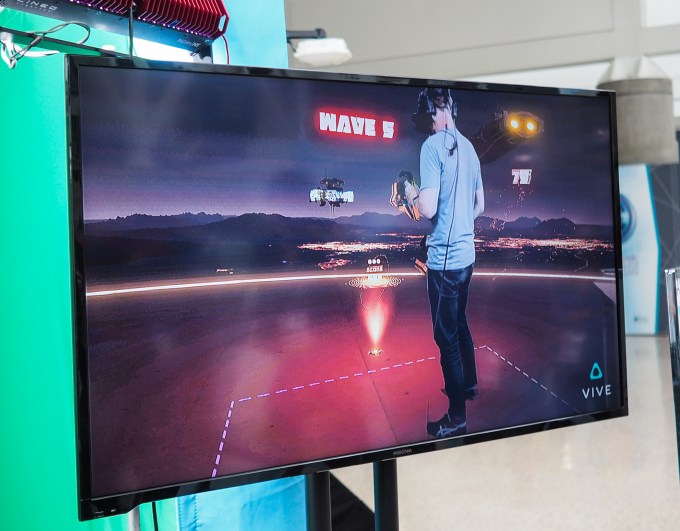
Another successful VR demo, at HTC, that showed room scale gaming that actually worked.
For decades, we’ve used gamepads, joysticks, keyboards, mice and other peripherals to make PCs and video game consoles understand where we’re looking at. With eye tracking, your computer already knows what you’re looking at and can react accordingly.
“When you want to interact with an object you just look at it and press a button,” says Werner. “The computer understands which object you want to interact with. You don’t need to drag the mouse or controller to the place you are already looking.”
Whether it’s about hacking at an object, aiming at a target, designating a location for the game character to run, or simply changing the direction of the point-of-view camera, eye tracking might make it a whole lot easier for gamers to interact with the gaming environment. This can mean a big deal for games that require a high level of mouse and controller handling.
While it might render previously challenging games too easy, it can also pave the way for games that are much more fast paced.
Eye tracking can also create a cleaner and less intrusive user interface.
“In games, graphical artists spend a lot of time creating beautiful environments,” Werner says, “and are in a constant battle with UI interaction designers that need to place UI elements on top, since it clutters the immersive feeling.”
With eye tracking, Werner explains, you can hide the UI or make it transparent and only make it visible when the gamer’s gaze is directed toward it. “This creates a more immersive feeling and solves a constant battle between graphical artists and UI designers,” he says.
For simulations and virtual worlds, eye tracking can enable gaze aware objects, where game objects or characters will react to the gaze of the player to make the simulation more realistic, Werner says. This means that you’ll have to be careful not to stare too long at a mercenary’s purse when entering a tavern in your favorite RPG.
Tobii itself offers a line of tack-on eye-tracking devices and eye-tracking embedded laptopsand has worked with gaming companies on eye-tracking-enhanced versions of popular games such as Rise of the Tomb Raider, Deus Ex and Watch Dogs 2.
It is unlikely that eye tracking will replace controllers any time soon, but according to Werner, thanks to the technology, “PC games will take into account one of the most powerful interaction methods we as humans have, our eyes. PC gamers will be able to utilize an additional control mechanism complementing the mouse and the controller. This will drive more natural and interaction without taking anything away.”

Medicine and accessibility

Medicine doctor hand working with modern computer interface as medical concept
Beyond the consumer level, the benefits of eye tracking expand to other realms where measurements of human gaze are key to obtaining results and insights.
“There is an increasing interest in using eye tracking to help diagnose — and potentially treat –neurological disorders,” says Bryn Farnsworth, science editor at biometric research company iMotions. “For example, infants usually like to look at images with people’s faces—scenes that have a social element.”
Farnsworth explains that infants that go on to develop autism are much more likely to have a preference for images that feature geometric shapes, while for children with the Williams syndrome, Farnsworth says, the situation is reversed, meaning that they show a marked preference for social scenes in comparison to neurotypical children.
This all suggests, Farnsworth says, “that the analysis of eye movements may help guide early diagnosis.”
research paper by students at UCSD states that eye tracking technology holds promise as an objective methodology for characterizing the early features of autism, because it can be implemented with virtually any age or functioning level.
Labs such as iMotions are helping researchers obtain those metrics through eye tracking devices in order to better understand and assess the conditions of patients.
Eye tracking company RightEye uses the technology to help physicians in administering test and finding symptoms for illnesses ranging from simple concussions to Alzheimer’s disease and dyslexia, and to help treat children with autism.
Eye tracking can also be a breakthrough for patients with physical disabilities, especially as affordable, consumer-level devices become available. “This is a large area for eye tracking and it is evolving,” says Tobii’s Werner. Gaze keyboards and control panels powered by eye tracking, Werner explains, give people with diseases such as cerebral palsy and spinal cord injuries a means to communicate, control their environment and develop skills through therapy.

Advertising

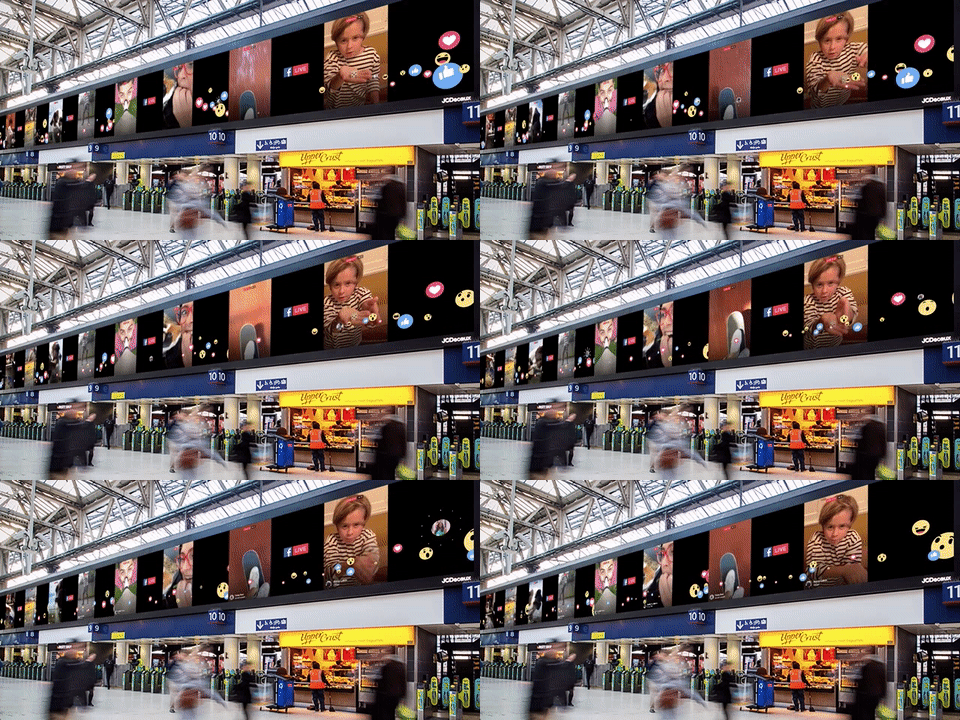
facebook-live-ads-gif
In the current state, the best metric advertisers get from ads are impressions and click numbers. But those numbers do not precisely reflect the effectiveness of ad campaigns because a lot of what gets counted as impressions goes to waste on non-human sources. That is something that changes with eye tracking technology.
“The advertising industry is currently in the midst of some major upheaval when it comes to universal standards for measuring ad impact,” says Porco, the Impax chief executive. “The whole concept of ‘viewability’ is now being redefined to make more sense in the age of ad blockers and bot traffic.”
With eye tracking technology, online advertisers will be able to measure exactly how many actual human eyes actually view their ads when they appear on the page. While gaining precise metrics would be nearly impossible until such time as every computer and mobile device is embedded with eye tracking technology, using eye tracking does give insights into how users interact with ads.
In the physical world, however, eye tracking is already showing promise.
“Market research firms are experimenting with directly measured biometric data to precisely determine the composition of people in out-of-home media environments such as retail stores, for audience measurement purposes,” Porco says.
Porco’s company, Impax Media, is investing heavily in eye tracking technology along with other computer vision techniques to collect attention metrics from its proprietary in-store advertising screens. “We’re big believers that the future of the ad industry is going to be grounded in attention metrics, as opposed to impressions, and eye tracking is, hands down, the best way to track attention,” Porco says.
The data, Porco says, helps advertisers and location partners to assess audience interest in various messaging angles, and to correlate this information with parameters like location, timing and demographics. “It’s great for media buyers seeking to get the most for their budgets, and for store managers dealing with questions about everything from inventory to staff shift schedules.”
While retailers always benefit from collecting information about customers, the area is somewhat a gray and is often subject to controversy and falls across privacy regulations. However, Porco underlines that there’s no need to collect identity parameter in order to glean useful insights, and anonymized data about gaze point, age and gender along with duration of view suffice.

Market research

research-kit
It’s important for market researchers to “evaluate people’s interactions and expectations across the whole omnichannel customer journey and its key touchpoints,” says Simone Benedetto, UX researcher at TSW, an Italy-based market research lab.
Recent advances in eye tracking, Benedetto explains, open up new possibilities in both lab and real world neuromarketing tests.
“It is crucial for us to involve users in product and service design and evaluation,” Benedetto says. “This doesn’t mean just to ask them their opinion, but to collect objective data coming from their eyes and brain while interacting with the product or service.”
TSW uses mobile eye tracking units along with other wearables in order to get precise user and customer metrics on a wide variety of products and services, both digital (such as online ads, mobile apps, websites, software and device control panels) and physical (such as print material, product packages, cars, home furniture and retail stores).
Being able to weigh the user’s natural interaction with products and services enables researchers to identify real usability problems and frustration points and collect actionable information that gives insights into customer satisfaction and engagement and drive design decisions.
“One of the great advances last year has been the introduction of object tracking in relation to the analysis of data from mobile eye trackers,” says iMotions’ Farnsworth, referring to the process by which specific visual features can be delineated from a scene, and information about how that particular feature is attended to can then be recorded.
“This means that an individual can, for example, wear portable eye tracking glasses, interact with their environment normally, and how they attend to certain features can be automatically analyzed —how long they look at a street map when they’re out walking, if they notice an advert that they passed,” Farnsworth says. “Being able to automatically understand how specific features are attended to clearly has great ramifications for understanding humans, and using that knowledge further.”
“From my perspective there’s a huge market behind the exploitation of eye tracking into UX-neuromarketing investigations,” Benedetto says. “Eye tracking allows the implicit measurement of user behavior, and turns that measurement into quantitative objective data. We have only relied on subjective data for years, and it’s definitely time for a change.”

The future of eye tracking
Close Up of blue eye with computer circuit board lines, digital composite
Tobii’s Werner told me he believes a new paradigm of PC usage will emerge, where eye tracking is a fifth modality that, in combination with touch screens, mouse/touchpad, voice and keyboard, will make computers much more productive and intuitive. “Gaze always precedes any kind of action that you do with mouse, keyboard and voice, so much smarter user interactions will be designed using these technologies,” he says.
As vision is the most used sense among human beings, being able to track and measure it digitally will have a great impact on how we make our intentions known to computers, wittingly or unwittingly.

Selasa, 18 Februari 2014

Disabled Pennsburg (PA) woman puts Google Glass to the test

Disabled Pennsburg (PA) woman puts Google Glass to the test

Sarah Brendle is will provide Google with input on how the device can help others with ALS.
Sarah Brendle was in her mid-30s — a typical married working mom with two young boys — when she began to notice weakness in her legs and a debilitating fatigue.

Consultations with several doctors led to a devastating conclusion: amyotrophic lateral sclerosis, also known as Lou Gehrig's disease, a degenerative disease of the neurological system that leads to paralysis and death.


Once the shock wore off, the Pennsburg woman started thinking about family milestones that might happen without her — soccer games played by her boys, Dillon and Eli, their birthdays, holidays.
                                
                                                                                                  
Fortunately, Brendle's disease has progressed slowly. Five years since learning she had ALS, that weakness is still there, but Brendle, now 40, can still walk and use her hands and arms. She also managed to have another child, Phoebe, who is 3.
The day will come, however, when she will find walking and even lifting her arm too difficult.
That's why she's excited to be participating in a beta test of Google Glass, which is essentially a wearable smartphone that can be operated with touch and voice commands. As part of development of the high-tech eyeglasses, Google is soliciting consumers' input, including the thoughts of people with disabilities.
As it works now, the wearer slips the device around the face like a pair of glasses. It can be worn alone or on top of prescription eyewear. Once the user starts it with a touch, he can activate applications with eye movement or a finger swipe on the side of the device. Information is projected as if viewed from a computer screen that is several feet away. It's not in the user's direct field of vision, so eyesight is not impaired.
It operates like a smartphone. Even with just a basic beta version, Brendle's Google Glass can take pictures, send messages and visit websites.
Brendle says it's "cool" to be part of the cutting edge of a new application of technology.
But in the not-too-distant future, Google Glass could allow people with ALS and other neurologic disabilities to perform daily activities and maintain independence, said Frank Hyland, vice president of rehabilitation at Good Shepherd Rehabilitation Network.
"It opens up the world to you," he said.
Brendle received the glasses last week from Alisa Brownlee, an assistive technologist at the ALS Association's Greater Philadelphia Chapter.
Not anyone can get Google Glass just yet. The company has some customers and so-called "Explorers" who request the early version of the device and, if approved, can buy it for $1,500. Brownlee said the foundation was approved and now is sharing it with Brendle and other people with ALS to get their feedback.
Brownlee looks forward to when Google Glass will help reconnect ALS patients to their communities, especially those who cannot afford adaptive vans costing as much as $40,000. If the individual is unable to get to an event, someone there can record a video of it and stream it to the user's Glass, where it can be viewed as it occurs. As any parent of a soccer player knows, fields can be far from parking lots, making attendance a big challenge for people like Brendle.
There are other obstacles. Snowy weather, for example, increases isolation for people with ALS.
"Some days, you don't feel you have the option to go out," Brendle said, noting that she's at high risk for falling any time.
Google Glass also could have practical, daily use too. Brendle said it could spare her the energy it would take to get up out of her seat to call her husband if she needs him when he's out of the house.
"I can tap it and send him a text saying, 'Can you come in five minutes?' Piece of cake."
Google Glass still needs tweaking before it can be embraced by all ALS users, Brownlee said. Some people with ALS cannot raise their arm to swipe it. Others have lost their ability to talk, rendering its voice activation useless. Those are challenges Google developers will have to overcome, she said.


One of the benefits Google Glass has over other technology is it doesn't require positioning, as eye gaze devices do, Brownlee said. That would help those who lose strength in their neck muscles and cannot keep their heads upright, she said. Eye gaze technology, first developed for military applications, uses an infrared light reader to give disabled people the ability to type with their eyes.
According to Hyland and John Grencer, administrative manager at Good Shepherd's technology program, Google Glass is one of a number of new devices that hold great promise for people with disabilities. The virtual reality headset called Oculus Rift may help those with limited control of their extremities, they said. Other technology in the works, but still far off, would use brain waves to command external actions.
They also foresee cloud-based software programs working with Google Glass that could help people with brain injuries remember to do daily tasks, or for those with autism spectrum disorders to recognize others' emotions.
It's all about finding ways to get technology to fit with human beings who have different needs and abilities.
                                                                                                  
"This has been the year of user interfaces," Grencer said.
Another benefit: Just as common technology like DVD players and smartphones got cheaper as they developed and attained market acceptance, so too will Google Glass. The current $1,500 price tag is expected to come down to around $500, they said. That's a lot more affordable and obviously a preferable option to an eye gaze device, which cost $30,000 a few years ago but still goes for around $7,500, Grencer said.
Google officials have been hazy about when a full retail rollout may occur, but it could be as soon as this year. They may soon have competition, as the Korea Times recently reported that Samsung is coming out with its version of wearable technology in the fall. Google's public relations staff did not return a message seeking further comment.
Meantime, Grencer and Brendle said Google should be commended for seeking input from a diverse group, including people with ALS.
The device certainly will "boost morale" among people with disabilities, Brendle said. Anything that increases their sense of security and independence will be embraced, she said.
"It gives them hope," she said, "because people with disabilities need something to be excited about."


Read more: http://www.mcall.com/business/mc-als-google-glass-20140216,0,654207.story?page=2#ixzz2tiBRirtQ
Follow us: @mcall on Twitter | mcall.lv on Facebook

Rabu, 03 April 2013

The Samsung Galaxy S4 and eye-tracking


The Samsung Galaxy S4 and eye-tracking


The launch of the Samsung Galaxy S4 last month garnered the type of media attention we’re getting used to for any new smartphone. Among the most talked-about feature pre-launch was “eye tracking” – the phone’s ability to know where its user was looking and react accordingly.
It took a few days for anyone to point out the application was more “head tracking” than eye tracking. As reported in the Wall Street Journal, it enables what Samsung is calling “smart pauses” and “smart scrolling”.


Face tracking and the Samsung Galaxy S4.

In short, the “smart pauses” feature recognises if you are in front of the phone or not, and can save what you were last doing when you move away from the device and decide to come back to it.
“Smart scrolling” refers to the phone’s inbuilt eye-tracking technology, which detects if the phone has been tilted and scrolls up or down accordingly.

An eye to eye-tracking

Eye tracking is a set of technologies and techniques for measuring where a person is looking (the point of gaze), for how long (fixation), and what are called saccades (fast movement of an eye).
The use of eye tracking dates back to the 19th century, when it was used to study reading behaviour and which words people focused on and which words people skipped over and revisit using analogue, observation-based techniques.

Eye tracking demo.

Since the 1980s, eye-tracking has been used in the field of human-computer interaction (HCI) for a myriad of purposes, including usability testing of interface design, and the development of computer navigation devices for disabled users.
Samsung’s innovation is likely the first step in realising the full functionality enabled in more advanced eye-tracking technology systems, such as those produced by companies including Tobii and Mirametrix.
Tobii, based in Sweden, is considered the industry leader in eye-tracking. The company develops hardware and software to analyse eye-tracking results, including goggle-based and traditional desktop systems.
Mirametrix, headquartered in Montreal, is a relative newcomer, and has developed more affordable eye-tracking equipment.


The new Galaxy S4 was unveiled in New York on March 14. Andrew Gombert/EPA

In terms of research and application, eye-tracking has been used in a wide range of disciplines, including vision research, psychology, cognitive linguistics, user experience testing and marketing.
Eye-tracking was recently used by the Australian media company Fairfax, as part of its neuromarketing research, to analyse the “eye-gaze” of readers on the ads in the smaller tabloid-size format of the new Sydney Morning Herald and The Age.
The company’s director of ad strategy was reported as saying the new format, from an advertising perspective, led to a “50% improvement in eye gaze”.
Eye tracking is currently being used in spatial cognition, to help understand how people relate to maps and geo-location, and in virtual reality, as shown in the video below. In computer gaming, eye tracking opens up new possibilities in game immersion, where players can aim and turn through “gaze interaction”.


Last September, the International Society for Photogrammetry and Remote Sensing (ISPRS) ran a workshop in Melbourne that included a hands-on session with eye-tracking equipment.
Participants were introduced to the Tobii eye-tracking system and participated in an experiment on understanding soil maps, maintained by the Victorian Department of Primary Industries via Victoria Resource Online.
This is believed to be the first workshop of its kind. Similar workshops, in which researchers and conference participants will gain exposure to eye-tracking software for spatial research, have been planned for later this year.

Looking to the future

Eye-tracking technology is gaining momentum. From a commercial perspective, there’s great value in understanding where people’s attention falls and for how long, especially when designing technology products and marketing pixel-based real estate.
In terms of research, there are many exciting opportunities for using eye tracking to understand visual processes and the ways in which people interact with information.
No-one would claim the Samsung Galaxy S4’s move into this area is, in itself, a game-changer – but it’s something of a game starter, and a sign of things to come.
Chris Pettit receives funding from the CRC-SI. He is affiliated with SSSI and ISPRS.

Rabu, 02 Januari 2013

Tobii REX brings Gaze eye-tracking tech to any Windows 8 machine

Tobii REX brings Gaze eye-tracking tech to any Windows 8 machine


Tobii REX brings eyetracking tech to any Windows 8 machine
Tobii may not be a household brand name yet, but that doesn't make the company's eye-tracking technology any less impressive. At last year's CES we got an opportunity to preview Gaze UI, an interface that allowed us to navigate, zoom, select and scroll on a proprietary Windows 8-enabled laptop with just our pupils and a touchpad; this year, Tobii is introducing the REX, a USB-connected peripheral that adds these features to any Windows 8 PC. The device, slightly larger than a pen, adheres to the base of any PC monitor and can be integrated with other existing controls such as the keyboard, mouse or touchpad. Though this may sound quite similar to the PCEye launched in 2011, it's different in that the REX isn't intended for use as an assistive technology, so you'll still need to keep that mouse and trackpad around. Consumer pricing and availability haven't been announced, but Tobii plans to offer 5,000 units to consumers before the end of 2013; for developers, however, a special edition (seen above) should be available starting today for $995.
Tobii REX brings Gaze eyetracking tech to any Windows 8 machine