-->
Tampilkan postingan dengan label aac. Tampilkan semua postingan

Senin, 13 Maret 2017

'Voice banks' step in to keep chronically ill patients from falling silent

'Voice banks' step in to keep chronically ill patients from falling silent


For thousands of Minnesotans with neurodegenerative diseases, losing one's ability to speak is one of the most devastating consequences.

Every so often, Robert White breaks into song and serenades his 13-year-old son Kieran with a tender Irish lullaby, “That Little Boy of Mine,” taught to him by his father.
But the deep-throated voice that used to fill his family’s living room in West St. Paul now quivers and shakes. There are times when White, who has amyotrophic lateral sclerosis, or ALS, a terminal disease that impairs his motor skills, can barely finish the chorus before his voice dips to a hoarsened whisper.
For White, and thousands of other Minnesotans afflicted with neurodegenerative diseases, losing one’s ability to speak is one of the most devastating consequences.
Now, however, researchers have found a way to preserve the unique essence of a human voice — in all its idiosyncratic nuance and power — for people with incurable and often debilitating illnesses.
Using new voice database technology, University of Minnesota speech pathologists can record people saying hundreds of sentences and phrases, break them down into phonetic units, and then reconstruct a personalized voice that can be used on a speech-generating device. The end result of this process, known as “voice banking,” is a voice that is nearly identical to the person’s original, healthy voice.
While the technology is still new, many people feel they are in a race against time to store their original voices before they become unrecognizable to their families and friends. Even the simple act of saying “I love you” can be too much of a strain for people in the later stages of ALS or other neurodegenerative illnesses.
“This is about preserving a person’s essential dignity, rather than having to depend on a canned synthetic voice that many find dehumanizing,” said Dr. H. Timothy Bunnell, director of the speech-language laboratory in Wilmington, Del., that pioneered the voice-banking technology about a decade ago.
But the process of preserving a voice is an emotional one for families. It comes with the recognition that a loved one is dying, and that even a carefully reconstructed voice — built over a period of weeks or months — will never be an exact match to a person’s original speech. Even the most sophisticated audio technology cannot recapture the spontaneous emotion of someone who bursts into laughter, or the gentle timbre of a parent’s voice as they sing to a child, researchers say.
‘It’s bittersweet’
On a recent morning, Wendy Eickhoff, 49, struggled to contain her emotions as she began the arduous process of recording more than 1,600 preselected sentences at a speech laboratory tucked in a brick building on the University of Minnesota’s East Bank campus.
Last October, Eickhoff was diagnosed with a rare form of ALS known as bulbar onset, which first attacks the muscles that move the tongue, mouth and vocal cords. It was a particularly brutal diagnosis for Eickhoff, a self-described “talker” who works as a technology relationship manager at Wells Fargo. Slurred speech and weakened tongue muscles were among her first symptoms.
“It was devastating because I have always relished talking,” she said.
As Eickhoff rattled off sentences in a soundproof room, including lines from the “The Velveteen Rabbit” and “The Wizard of Oz,” her daughter Logan, 21, watched intensely through a window in an adjoining room. With a tinge of sadness, Logan expressed hope that voice banking would preserve the unique character of her mother’s speech, from her high-pitched laugh to the gentle way she called out “Good morning sunshine!” to her daughter each morning.
At one point, Logan broke down in tears after a speech pathologist calmly informed her that her mother’s recorded voice would survive her death and would always be available to the family.
“It’s difficult, really difficult,” said Logan, who is pursuing a degree in linguistics. “I don’t want to have to acknowledge that in the potentially near future that my mom won’t be able to speak. But I also feel lucky, because this means that even after she’s gone, I’ll be able to hear her voice. It’s bittersweet.”
Those who have been through the process speak of it in glowing terms.
When Robert White finished recording the last of 1,610 sentences last month, after five grueling sessions, he threw up his hands in victory and handed out assorted chocolates to the speech-language pathologists and young students who helped him through the process.
“There is a real sense of accomplishment when you get to the end,” said his wife, Argerie White. “I mean, how wonderful would it be, if Bob ever loses his voice, that we can still hear him sing?”
Sophisticated technology
Until recently, people like the Whites and the Eickhoffs relied on interactive whiteboards or robotic synthesizers, similar to that used by renowned physicist Stephen Hawking, to communicate with the world after illnesses had taken their speech. But voice-banking technology has become so sophisticated that it can now cull through thousands of phonetic syllables and sort them in a way that replicates the pattern of a person’s speech. The recording process emphasizes the repetition of vowels, because the medley of “ohs” and “ahs” are largely what make a person’s voice distinctive, researchers say.
While the technology is still being tested and enhanced, that has not dissuaded the regional chapter of the ALS Association from encouraging people with the disease to take advantage of the technology while their voices are still strong. The voice-banking service is now available at university speech clinics throughout the Upper Midwest, from Fargo to Duluth. The cost of creating a voice can run from a few hundred dollars to more than $1,000, depending on the provider. In Minnesota and the Dakotas, the cost for those with ALS is covered by the regional ALS Association.
“It’s crazy-amazing how well this works,” said Rebecca Lulai, a clinical supervisor and speech-language pathologist at the University of Minnesota.
Pete Klinkhammer, who remembers the exact minute he was diagnosed with ALS (11:47 a.m. on June 14, 2013), was among the first to test voice-banking in Minnesota and is now an outspoken proponent. Klinkhammer, 54, a gregarious former social worker from Albertville and bulky ex-college football player, has a bellowing laugh and a penchant for off-color jokes and puns. The technology enables him to keep speaking through an iPad, often late in the evening, when his throat muscles cramp and his voice starts to slur.
During a recent visit with his 28-year-old daughter Chelsea, Klinkhammer pulled out his iPad and began tapping out a few of his favorite puns as his daughter watched with amusement.
“A guy just threw milk at me. How dairy!” he wrote, throwing his head back in laughter. The words “I love you, Chelsea,” came out of a small speaker attached to his iPad with virtually the same inflection as his regular voice.
“That is definitely your voice, Dad,” gushed Chelsea, hugging him.
“This illness can come to define you because it takes away so many outward physical aspects of your being,” Klinkhammer said. “But voice banking epitomizes the idea that this illness can’t take everything away, because it can’t take away your voice.”
 Via http://www.startribune.com/new-technology-helps-minnesotans-with-neurological-disorders-preserve-their-voices/415954614/

Rabu, 01 Maret 2017

I Played The First-ever Eye-controlled Instrument At The Sydney Opera House


As a result of a complicated birth I have severe cerebral palsy. My condition affects my fine motor skills and causes my body to endure involuntary muscle spasms. Despite my physical disability I have always been an outgoing and creative person. Throughout my life I have been known to overcome barriers and push myself to achieve the next step at every turn. This is a tough gig sometimes, however when you don't fit into the so-called box, you strive to become a game changer. My past is full of critics who grossly underestimated my capabilities, but I just convinced myself to keep pushing forward and change their perception and help spread awareness.
For me, being independent in my business life means so much.
I can remember how difficult it was progressing through school not knowing what the future held due to having a severe physical disability. Today while illustrating what is possible to younger generations I hope to build their confidence and allow them to challenge their own barriers.
Through the use of technology, I am able to be fully independent in my work environment, from using a Macbook for my graphic design and website development, to securing my SLR digital camera to my wheelchair. For me, being independent in my business life means so much.
I have always been surrounded by music. I found that by immersing myself in beats and rhythms decreased my physical pain and lessened the severity of my spasms. One of the reasons I took up music photography was to satisfy a strong urge I had to join my musician friends on stage. Until recently I was forcing my inner musician to be satisfied with just doing event photography, knowing I could never physically pick up an instrument and start playing.

A few years ago, I was lucky to cross paths with Dr Jordan Nguyen at a conference. He was delivering a presentation about his mind-controlled wheelchair. At the time, Jordan was predominantly working with quadriplegics. I wasn't aware that he had never conversed with a non-verbal person with Cerebral Palsy before. He later confessed after our meeting his perspective drastically changed when he realised there was a whole different level of people with disabilities he could work towards assisting.
As time went on Jordan and I became really good friends. Just like me, Jordan has what it takes to break new ground and create new technology that allows others to push forward in their lives. Having very similar goals to Jordan I started becoming involved in his social business Psykinetic where I have a strong sense of belonging. The team at Psykinetic have a common sense of purpose and want to create new technologies purely to empower people in the same physical situation as me.
We went to a few music gigs where Jordan witnessed firsthand how much I wanted to perform like my rock and roll musician friend, Steve Balbi, from Mi-Sex. Every time I watched Steve on the stage, I could hear my inner musician screaming "You need to play music and perform!" However, my logical side just dismissed that idea as a result of my physical limitations. Well... that was until Jordan decided to find some way to get me on stage and enable me to physically play an instrument.
One morning I received a phone call from Jordan asking for my participation on a new project... without hesitation I said "yes". The idea was for me to play classical music at the Sydney Opera House alongside the Australia Piano Quartet, with the first ever eye-controlled instrument from Psykinetic. I hadn't used eye control technology before and knew absolutely nothing about classical music, and I was sitting there thinking how are we going to make this happen, it is classical music at the Opera House?! That is a massive thing to accomplish, however I knew with Jordan's and my determination we just might make this dream happen.
It was very strange because this iconic building was where I had watched some of my favourite musicians play in the past. Then, suddenly, I was on the same stage.
I picked up the software really quickly. However I still needed to be taught how to play classical music on the instrument with a seemingly impossible deadline of four weeks.
Time to bring in the Australia Piano Quartet. James Wannan took the lead as my music teacher. Playing at the Opera House with the piano quartet was a very surreal feeling. It was very strange because this iconic building was where I had watched some of my favourite musicians play in the past. Then, suddenly, I was on the same stage. If a standing ovation is anything to go by, I think we pulled it off.
So what is next for me? Do we have time for me to list everything? I would love to continue my work with the Australia Piano Quartet and grow my music skills, and spread awareness to what is possible with this type of technology from Psykinetic. My desire is to assist in making their technology more available so more people like myself have the opportunity to explore what is actually possible.

Kamis, 23 Februari 2017

Microsoft app helps people with ALS speak using just their eyes

Microsoft app helps people with ALS speak using just their eyes


https://www.newscientist.com/article/2121579-microsoft-app-helps-people-with-als-speak-using-just-their-eyes/

A smartphone held up in front of a person gazin to the right, showing the GazeSpeak app on the phone screen
The eyes say it all
GazeSpeak, Enable Team, Microsoft Research
It can be difficult to communicate when you can only move your eyes, as is often the case for people with ALS (also known as motor neurone disease). Microsoft researchers have developed an app to make talking with your eyes easier, called GazeSpeak.
GazeSpeak runs on a smartphone and uses artificial intelligence to convert eye movements into speech, so a conversation partner can understand what is being said in real time.
The app runs on the listener’s device. They point their smartphone at the speaker as if they are taking a photo. A sticker on the back of the phone, visible to the speaker, shows a grid with letters grouped into four boxes corresponding to looking left, right, up and down. As the speaker gives different eye signals, GazeSpeak registers them as letters.
“For example, to say the word ‘task’ they first look down to select the group containing ‘t’, then up to select the group containing ‘a’, and so on,” says Xiaoyi Zhang, who developed GazeSpeak whilst he was an intern at Microsoft.
GazeSpeak selects the appropriate letter from each group by predicting the word the speaker wants to say based on the most common English words, similar to predictive text messaging. The speaker indicates they have finished a word by winking or looking straight ahead for two seconds. The system also takes into account added lists of words, like names or places that the speaker is likely to use. The top four word predictions are shown onscreen, and the top one is read aloud.
“We’re using computer vision to recognise the eye gestures, and AI to do the word prediction,” says Meredith Morris at Microsoft Research in Redmond, Washington.
The app is designed for people with motor disabilities like ALS, because eye movement can become the only way for people with these conditions to communicate. ALS progressively damages nerve cells, affecting a person’s ability to speak, swallow and eventually breathe. The eye muscles are often some of the last to be affected.

Board of the old

“People can become really frustrated when trying to communicate, so if this app can make things easier that’s a really good thing,” says Matthew Hollis from the Motor Neurone Disease Association.
There are currently limited options for people with ALS to communicate. The most common is to use boards displaying letters in different groups, with a person tracking the speaker’s eye movements as they select letters. But it can take a long time for someone to learn how to interpret these eye movements effectively.
GazeSpeak proved much faster to use in an experiment with 20 people trying both the app and the low-tech boards. Completing a sentence with GazeSpeak took 78 seconds on average, compared with 123 seconds using the boards. The people in the tests did not have ALS, but the team also got feedback on the technology from some people with ALS and their interpreters. One person who tried the device typed a test sentence in just 62 seconds and said he thought it would be even quicker in a real-life situation, as his interpreter can more easily predict what he is likely to say.
“I love the phone technology; I just think that would be so slick,” said one of the interpreters.
Other systems currently use software to track eye movements with infrared cameras. But these are often expensive and bulky, and infrared cameras don’t work very well in sunlight. The GazeSpeak app is portable and comparatively cheap, as it only requires an iOS device, like an iPhone or iPad, with the app installed.
Microsoft will present the app at the Conference on Human Factors in Computing Systems in Colorado in May. The researchers say it will be available on the Apple App Store before the conference, and the source code will be made freely available so that other people can help to improve it.

Rabu, 01 Juni 2016

‘It's as simple as just talking’: VocaliD gives a voice to the voiceless

‘It's as simple as just talking’: VocaliD gives a voice to the voiceless


Imagine losing your voice. Not just for a minute, a day, or even a week. Imagine it’s not there anymore. Ever. How would you cope?
Until now, people only had access to limited technology that made everyone sound alike, with robotic tones, much like Stephen Hawking. While it’s a huge, and important, step from being mute, the speechless have sought something more human, more personal — more ‘them’.
Speech scientist Rupal Patel is helping break down communication barriers for the more than 10 million people without a voice through the groundbreaking technology, VocaliD, where Patel is chief executive officer. The company is pioneering the customization of digital voices and is working with Saatchi & Saatchi New York to help tell the story.
“We're entering in the market for assistive technology where people have to have this voice. They don't have other choices, and until now they've been given these generic sounding voices,” explains Patel, who gained wider recognition for the technology through an inspiring TED Talk.
Patel wanted to personalize the experience and she founded the company in 2014 to create custom vocal identities and celebrate the diversity of the human voice. The great thing is, anyone can contribute a voice. They just have to log on to the company’s website, turn on their computer’s microphone and record several sentences. The company then logs that voice into The Human Voicebank. This crowdsourcing of voices currently has logged over 11,000 speakers in 110 countries, and makes it affordable for anyone without a voice to get a match that fits their gender, age and personality. Essentially, it helps create a vocal DNA for the voiceless.
In addition, if someone may be losing their voice to a disease or a condition, or if for some reason they want to preserve their voice for the unexpected, they can log their own voices. Patel sees The Human Voicebank as a better way than having one voice actor recording many statements over days in a studio.
“We want to have a technology match. [What] we're able to do with six hours of someone's voice isn't going to be the same as creating a Siri-like voice for millions of dollars and lots and lots of hours. We're really pushing the envelope on technology and even the pricing part of it to see how we can get this off the ground. We do see that more and more things are going to start to talk, and we're going to be relevant then too, to that broader market,” says Patel.
Goldivox
Generating interest in the technology is Saatchi & Saatchi New York, who have created an engaging, interactive animated video. Goldivox tells the story of a little girl, unable to speak, who searches to find her perfect voice match. She travels the globe until she finally finds a girl whose voice is perfect. The interactivity comes when you speak the words on the screen and they are recorded during the story, changing the story as the user speaks. It not only gets the word out about VocaliD, it also encourages people to become a part of the voice bank.
“This was a very unique challenge that demanded a unique solution,” comments Jay Benjamin, Saatchi NY’s chief creative officer. “We hope this interactive storytelling experience will help people feel how powerful their own voice can be, and that they will be compelled to donate their voice through VocaliD or even spread the message to others who might donate theirs.”  
Patel is excited about the interest the Goldivox video can generate.
“As we understand Goldivox’s need to find a voice that fits, we discover that each one of us has the power to share voice. The interactive read-along invites you to empathize, act upon and cheer on Golidvox all in one. It’s so exciting to have the creative genius of the Saatchi team bring our vision to life through Goldivox’s voice.”
Benjamin said the interactivity came about somewhat by chance.
“The interactive component of it came as we worked through this together with VocaliD, and just sitting together, said, ‘wouldn't it be cool if this wasn't just an animated story, but if the viewer could actually use their voice to move the story along?’”
Goldivox
For Patel, developing the technology and taking it out of the lab was personal, in that she wanted to help those with disabilities who didn’t have a voice.
“They're people, and they have a voice. How do we make it so that they have their own voice because really we haven't really leveled the playing field until you give them a voice that makes them feel like a human being as opposed to just a robot, right? Seeing people with disabilities as fully human is definitely what's personal driving this. Everyday people don't even know that people with speech disabilities suffer or have to deal with this kind of technology. They just don't know. They don't meet them. They don't encounter them,” adds Patel.
“Communication disability is so isolating that people kind of get removed from society, and my hope is that they can re-enter society and be themselves. But I think it's also timely because everyone else, the people that aren't disabled, participate in that movement. I think that's the coolest thing. I can share my voice with someone who can't speak. The fact that I can do something so meaningful for them, I think people are dying to do meaningful things for people. The fact that I can record in my own home, off my own computer, that ubiquity of recording and people understanding how they can do those things pretty easily. It's all about timing, both in the social realm but also in the technological realm.”
The story of Goldivox and its interactivity is helping bring greater awareness to the cause, and Benjamin believes some of that comes from the way those who interact with their voices can steer the story.
“When we see people interact with the story it’s one of the things that actually draws them even closer to it, because their voice is the thing that's making the story happen. So you're living and breathing how your voice is going to bring someone else's story to life. And I think it's a very innovative and forward-thinking style of storytelling that I think can be used in other formats as well,” he says.
Benjamin found Chilean animator Tomas Vergara through Saatchi’s Cannes new directors showcase last year — and he essentially created the entire animation for the project, enhancing the interactivity and underscoring the commitment of those involved in telling the VocaliD story. Benjamin sees opportunities for interactive stories to develop for kids with this technology, having them be an integral part of the story, kind of like the old ‘Choose Your Own Adventure’ books, but digitally.
For her part, Patel has been approached about expanding the technology to help more people. Reading apps for people with low vision, and customizing voices for other interactive stories are possibilities. But for now, VocaliD is focusing on making lives better for the voiceless — and counts numerous times that she has received inspirational feedback from those who have used the technology, including adults and children who finally found a personality through their new voices.
“One man who we made a voice for recently had lost his voice to ALS (amyotrophic lateral sclerosis, also known as ‘Lou Gehrig’s disease’), but he didn't have any recordings of himself. It had been eight years since he and his wife had heard a voice that sounded like him. We created three different options for him. The first couple he just politely nodded and was just like, ‘Yeah, that's pretty cool. It's different than what I'm using right now.’ The third one, when he heard it, his entire body went into the shakes for a minute-and-a-half, and his wife's face changed color. Initially, I didn't know what that meant; I didn't know what they were signaling. I've gotten to know them for the last year and a half or so, and I was really nervous about playing the voice sample. What they told me, after the tears and the shaking stopped, was, ‘Oh my gosh, this is remarkably like his voice.’ There's something about voice that re-acquaints us with a person. That's really powerful in terms of finding your voice again in that scenario,” Patel shares.
Saatchi & Saatchi will continue to develop a campaign for VocaliD, including one that recruits more people to contribute their voices. They hope that it helps change people’s perception of those without a voice.
“Eventually I hope that that will trickle down to changing our attitudes about people with disabilities and what we can do about it. I think there is a complacency sometimes that we have about, ‘Well, what can I do? How can I help someone who can't speak? I don't have those skills.’ Well, you do. It's as simple as just talking. Having kids do this activity, adults, people of all ages, we need all those different voices to create the variety of voices we need. It is in so many ways the ultimate education campaign, right? A public education campaign,” Patel concludes.
Goldivox
----
Credits
Creative / Production: 
Chief Creative Officer: Jay Benjamin
Creative Director: James Tucker
Creative Director: Billy Leyhe
ACD: Brad Soulas      
Art Director: Ryan Gifford
Copywriter: Callum Spencer
Copywriter: Devin McGillivary
Business Design Director, New York and Worldwide: Blake Enting
Designer: Christopher Kelly
Head of Film: John Doris
Producer: Tegan Mahford
Animation: Peak Pictures/Tomas Vergara
Interactive Design and Development: Potato London
Head of Production: Lir Cowman
Business Development Director: Oliver Matthews
Lead Developer: Stu Cox
Developer: David Martin
Project Manager: Jemma Kamara
Project Manager: Adam Field

Music: Massive Music
Sound Design: Daniel Ferreira

Rabu, 11 Mei 2016

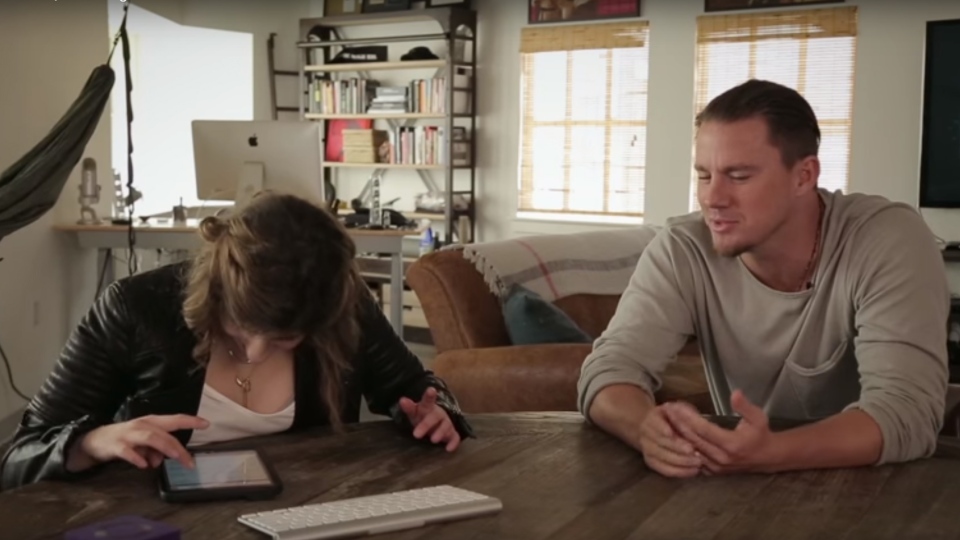
Channing Tatum adds star power to Carly Fleischmann's non-verbal talk show

CTV National News: A non-verbal talk show?
Carly Fleishmann can't speak, but she's opening up a world of possibilities by communicating through typing. Avis Favaro reports. 
3K
3K

    Karolyn Coorsh, CTVNews.ca Staff
    Published Friday, May 6, 2016 10:15PM EDT 
    A smart and sassy 21-year-old who has autism has created a talk show in the hopes of inspiring others to find their voice.  
    Carly Fleischmann, of Ontario, can’t speak, but that hasn’t stopped her from launching what is believed to be the world’s first-ever non-verbal talk show.
    The online show, called “Speechless” is going viral after she snagged one of Hollywood’s hottest stars for her debut interview – actor Channing Tatum.
    As host of the show, Fleischmann types her questions, which are then voiced by her computer and posed to the interviewee.
    Many people assumed that Fleischmann’s future was limited after she was diagnosed with autism and oral motor apraxia at age two. But after learning to type, Fleischmann revealed her razor-sharp mind. Since then, she has co-published a book, appeared on multiple TV shows, and is now aiming to become the world’s first non-verbal talk show host with autism. Her objective, she says, is to “prove that it doesn’t matter what comes out of your mouth, it’s the voice within that needs to shine.”
    And she doesn’t shy away from the asking provocative questions.
    In her interview with Tatum, Fleischmann asks, “Would you date a 21-year-old person with autism?” Tatum quips: “Yes … but I have to get my wife’s permission first.”
    Fleischmann’s shoots back: “Alright, I’ve got my lawyers working on your divorce papers as we speak.”  
    And she didn’t stop there, asking Tatum about his previous career as a male stripper. “How many girls at the end of your night would take you home” she asks as Tatum laughs.
    Her mother, Tammy Starr, said she was “laughing my head off” when saw the interview.
    “I couldn’t believe the question,” Starr said of her daughter’s bold style. “These are questions he’s never been asked … before.”
    Fleischmann is hoping a major network picks up her show.
    Laurie Mawlam, executive director of Autism Canada called Fleischmann an inspiration.
    “Ultimately, we should all follow our dreams and that is what she is doing,” Mawlam told CTV News. “Autism is not an obstacle for her.”
    With a report by CTV News medical specialist Avis Favaro and producer Elizabeth St. Philip